A Memory Called Empire – Arkady Martine (Teixcalaan, book 1)

You pump the dead full of chemicals and refuse to let anything rot—people or ideas or … or bad poetry, of which there is in fact some, even in perfectly metrical verse,” said Mahit. “Forgive me if I disagree with you on emulation. Teixcalaan is all about emulating what should already be dead.” “Are you Yskandr, or are you Mahit?” Three Seagrass asked, and that did seem to be the crux of it: Was she Yskandr, without him? Was there even such a thing as Mahit Dzmare, in the context of a Teixcalaanli city, a Teixcalaanli language, Teixcalaanli politics infecting her all through, like an imago she wasn’t suited for, tendrils of memory and experience growing into her like the infiltrates of some fast-growing fungus.

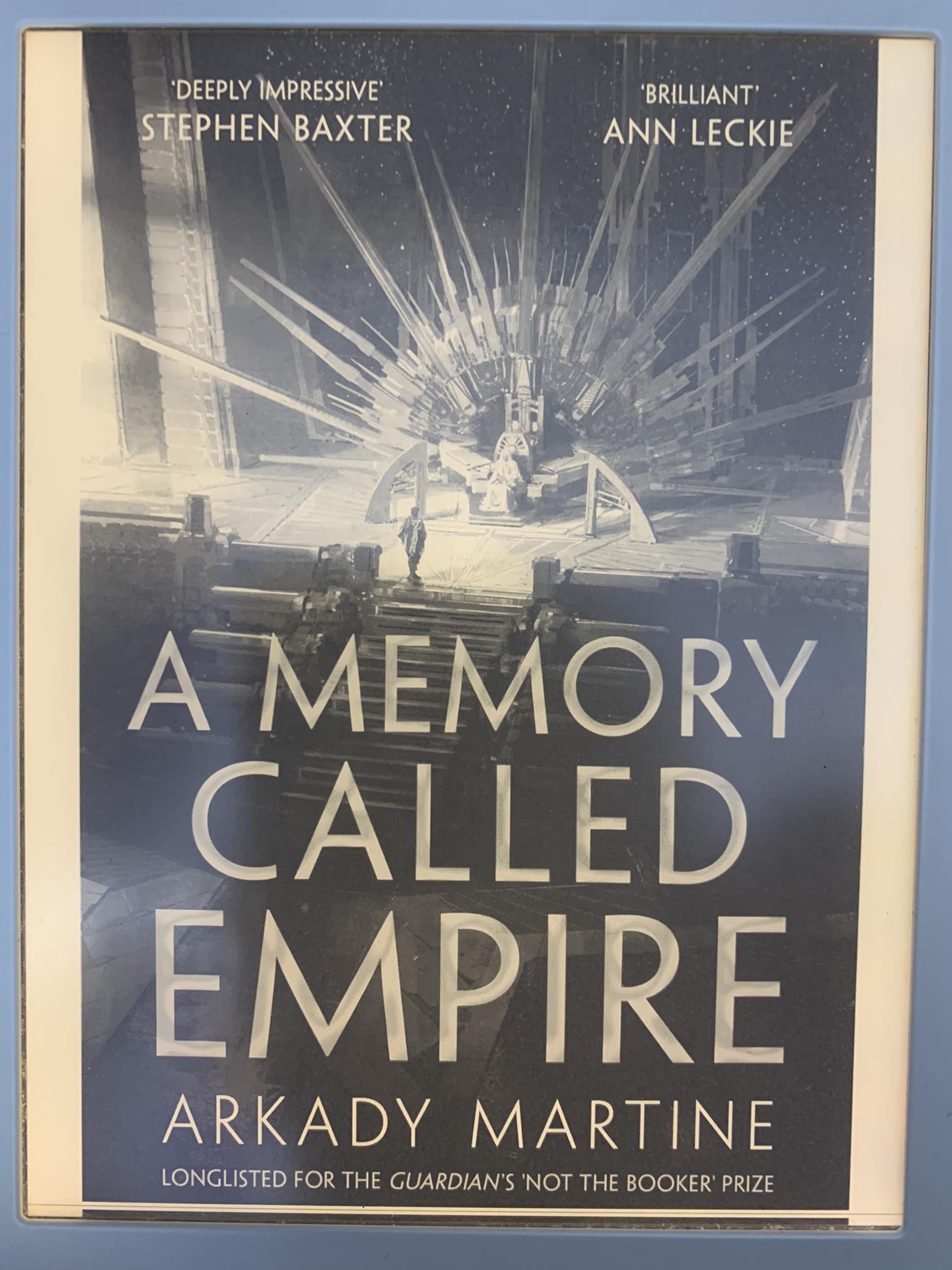
The book follows the arrival of the new ambassador, Mahit Dzmare, from the independent Lsel station to the empire of Teixcalaan, and her adventures following the murder of the previous ambassador, all while trying to preserve the independence of a her small station. This is a detective thriller, intertwined with imperial intrigue and friendship, on the streets of the monumental capital of the largest interstellar empire.

This is the debut novel for the author AnnaLinden Weller, writing under the pseudonym Arkady Martine. The novel won the Hugo Award and was a finalist for the Nebula Award for Best Novel of 2019.

What is impressive in this book is the quality of prose, exceptional world-building, relatively uncomplicated plot and the memorable characters. The names chosen are unique and the book creates a new vocabulary for this glorious empire of Teixcalaan. One of the profound themes explored is of self and multiple identities, via a device called imago machine, which preserves the memory of the deceased and allows to be incorporated in a new person. The results are generally positive, the deceased being of help, but not without risks.

While usually not my type of book (it was more fiction than science), the quality of prose was undeniable and the story engaging. It is a long book, but hours of reading passed unnoticed, showing the grip that the book makes on the reader. At the no point the story stagnated or paragraphs felt unneeded, despite it’s considerable length. A highly entertaining book.

Statecraft – Margaret Thatcher

The West as a whole in the early 1990s became obsessed with a ‘peace dividend’ that would be spent over and over again on any number of soft-hearted and sometimes soft-headed causes. Politicians forgot that the only real peace dividend is peace.

The book is an analysis of the international affairs by the former British Prime Minister, Margaret Thatcher. The book’s chapters are organized geographically, by country or region, but they also have some chapters on the fundamentals of classical liberalism. The analysis aims to guide and advise young politicians on a continuously changing world.

Strongly opinionated, Thatcher argues vigorously for free markets, strong military, prosperous economy, freedom of choice, limited state intervention, rule of law and British exceptionalism. What made Thatcher impressive was her 3 consecutive won elections, despite tough social measures.

The book is from 2002 and appears, in some respect, outdated. However, in many ways, the former Prime Minister was spot on in her analysis of the trends: the autocratic nature of Russia, the prosperity that free markets will bring to China, the bureaucratic European Union, the allure of social measures and strength and enterprise of the United States of America.

The volume is quite long and dense, but every chapter has at the end several main points, highlighted in a bullet-point, bold format, which makes the reading easier. many of her speeches are quoted in the book, but they are well inserted and the book is not just a collection of speeches.

While reading the book, I found myself wondering how many people will actually vote for her today. She combined a strong leader, with clear views, a well organized politician, a woman in a world of mostly men and a conservative liberal in one person. It is interesting that conservative parties, which do not have any gender quotas, but rather look at merit, brought forward most world prime ministers, to what I can remember.

I enjoyed the book, it was entertaining and timeless, pensive, intriguing at times, strong in both criticism and defending the values that she stood for. She must have been a truly remarkable stateswoman.

Colonisation (Tome 6) – Denis-Pierre Filippi, Vincenzo Cucca

Les équipes de l’Agence ont été attaquées. Une branche indépendante d’Écumeurs dirigée par un certain Raylan est parvenue à s’infiltrer dans le vaisseau du Commodore Illiatov. Leur assaut, s’il était destiné à la récolte de données concernant les nefs perdues, ne sera parvenu qu’à une chose : mettre fin à la vie de nombreux agents et notamment à celle du Commodore lui-même. Raylan et ses sbires sont en fuite et mènent la danse, agissant toujours avec un coup d’avance. La menace s’intensifie, les morts se multiplient et l’escouade de Milla réalise peut-être trop tard que l’ennemi qui lui fait face est le plus rusé et le plus redoutable qu’elle ait jamais eu à affronter.

Colonisation est le 6ème tome de la série des bandes dessinées par scénariste Denis-Pierre Filippi et dessinateur Vincenzo Cucca. Les dessins et le scénario sont captivants et clairement profondément pensés. La série est imaginative et pleine d’action. Les inconvénients sont le manque de science dure à certains moments, comme aller sur une planète extraterrestre dangereuse (haut de gamme) par l’équipe de recherche sans casque.

Le context de l’histoire est l’humanité dans le futur, envoyant des colonies dans le grand espace. Cependant, des extraterrestres bien intentionnés offrent à l’humanité le cadeau de voyager vite dans l’espace. Les colonies sont un prix élevé du marché noir et l’Agence est formée, pour trouver et protéger des braconniers maléfiques ces colonies perdues. La série suit les aventures de l’agence dans sa mission de défendre les colonies humaines perdues.

Dans ce volume 6, l’Agence tente de capturer un braconnier habile appelé Raylene, qui s’avère plus ingénieux et impitoyable que prévu.

Défendre les colonies humaines perdues contre les braconniers maléfiques dans le futur lointain de l’humanité.

Le volume était captivant et les dessins capturaient magnifiquement l’immensité de l’espace et de l’humanité dans le futur. Si l’histoire est forte, les dialogues sont moins forts que les illustrations, qui sont vraiment mémorables. Les scènes d’action et l’histoire elle-même sont bien mises en page et facilitent la lecture et le suivi de l’action pour le lecteur.

Dans l’ensemble, même si elle manque parfois de science dure, la série est captivante et avec des illustrations mémorables.

EU Electricity Policymakers’ (in) Sensitivity to External Factors (Article)

Below is the abstract of an article I wrote for the International Journal of Energy Economics and Policy in autumn 2021. Link to full paper at the end of the post.

The article explores a possible reason for the consistent dominance in the EU energy space of one energy policy priority, environment, when a more balanced policy would be expected, according to the classical energy trilemma.

Stemming from a policy dynamics theoretical background, the sensitivity of EU policymakers to external factors is quantitatively tested by comparing legislative output against key relevant indicators, such as the public opinion and air pollutants emissions. The study encapsulates the last three decades, across all the three energy pillars of the energy trilemma, plus a fourth, internal energy market. The investigation converts into ordinal values data from selected indicators so as to create comparable scales.

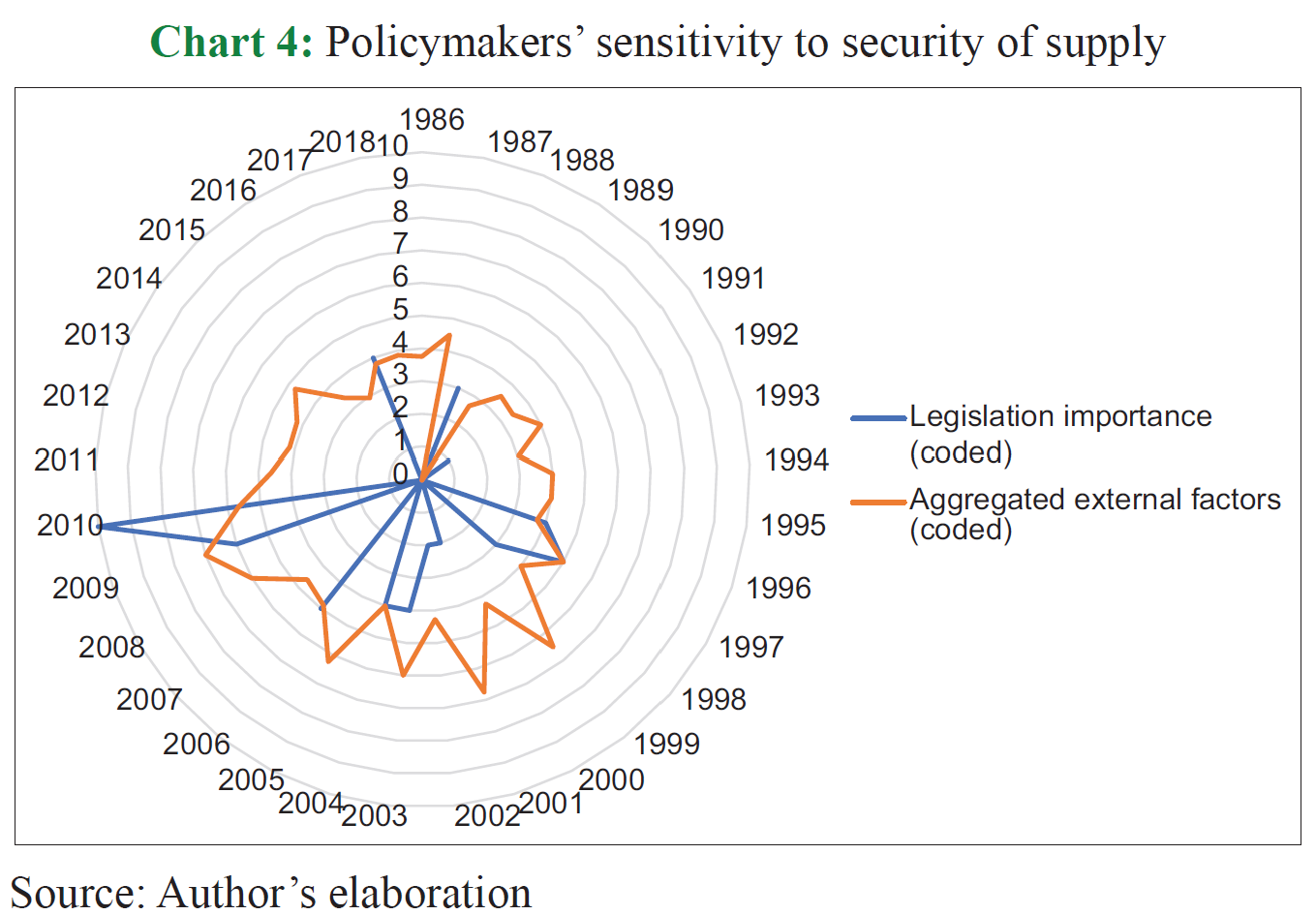
Results show that, unlike other energy pillars, which display strong connections between external factors and legislative output, environment legislation is rather indifferent to external factors pressure. Possible explanations are incorrect policy calibration or internal factors, originating in the rational choice realm.

This research is one of the first to introduce comparative assessments in the Environmental Policy Integration discussion and employs in novel ways research methods for energy policy analysis emerged in the field of energy security policies.

DOI for full article: https://doi.org/10.32479/ijeep.11630

EU Electricity Policy (Im)balance: A Quantitative Analysis of Policy Priorities Since 1986 (ARTICLE)

Below is the abstract of an article I wrote for the International Journal of Energy Economics and Policy in 2021. Link to full paper at the end of the post.

The European Union has produced hundreds of laws in the field of electricity policy in the last three decades, on issues ranging from nuclear disposal to renewable energy generation support. Is the EU electricity policy of the last 30 years balanced, according to the classical energy trilemma framework?

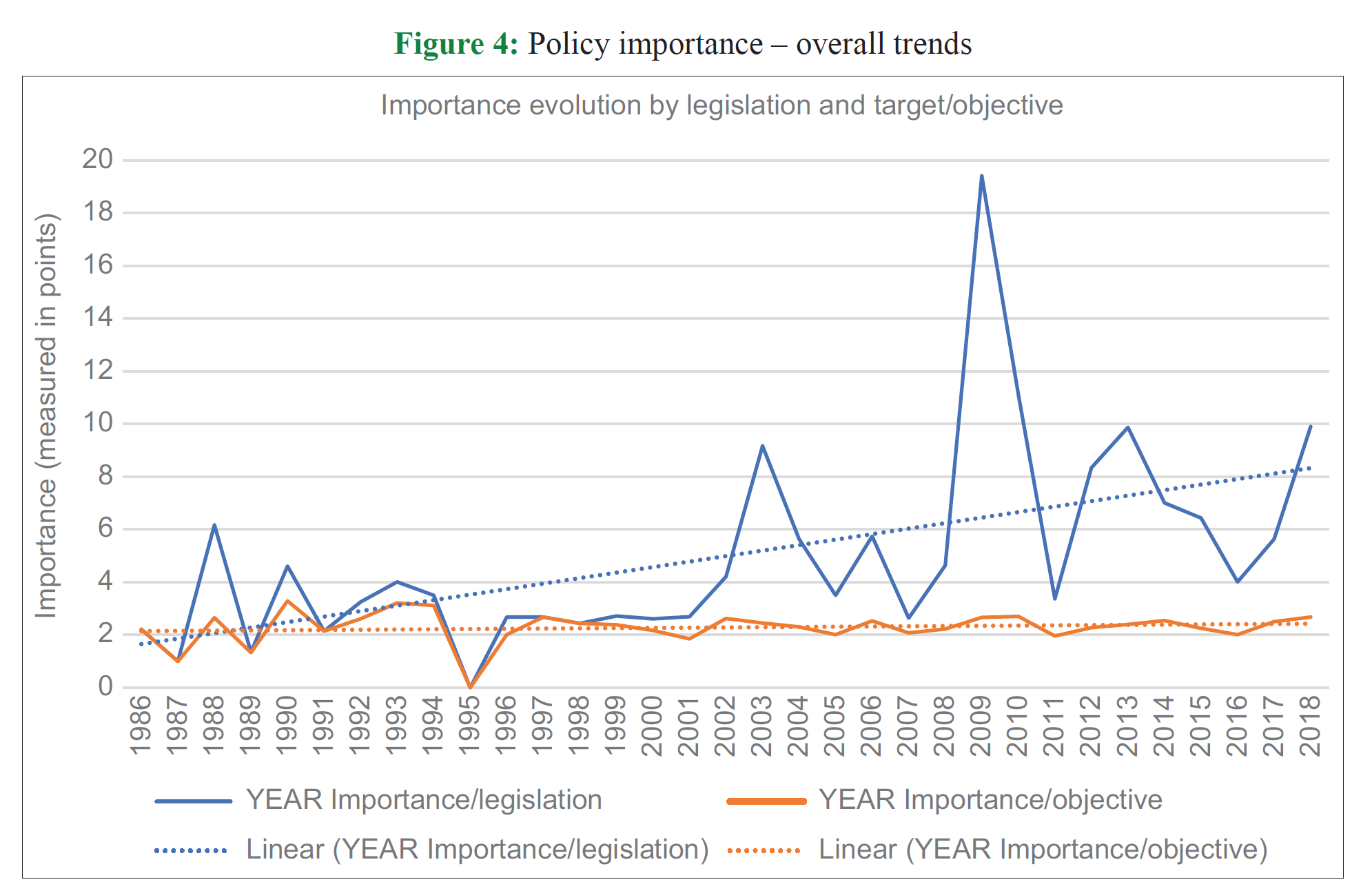
An all-inclusive, quantitative, multi-decade examination of the EU energy policy is still lacking. Besides the traditional policy perspectives, policy density and intensity, this paper proposes a novel method to measure policy outcomes: policy importance. The results show that EU energy legislation is indeed imbalanced.

Environmental concerns rank first among EU electricity policy priorities; however, since 2003, the creation of an internal market has started to challenge environment as the top priority. Furthermore, internal market policies tend to have a higher trend of adoption than environment. Security of supply is at the bottom of EU policymakers’ attention.

The EU energy policy is becoming more intricate, but not more revolutionary. Meaningful policy changes occur at a stagnating yearly rate, despite the increasing power of the EU institutions.

DOI for full article: https://doi.org/10.32479/ijeep.11461

Assessing European electricity policy goals and achievement levels (ARTICLE)

Below is the abstract of an article I wrote for the 13th International Conference on Energy Economics and Technology in 2019. Link to full paper at the end of the post.

Our aim in this research paper is to assess the evolution of European Union’s electricity policy ambition. To find its electricity policy ambition we identify the targets and objectives of EU legislation and analyse their evolution in time, for the four main pillars of the EU electricity policy and for our selected categories.

The assessment is based on a policy density and policy intensity analysis. The empirical research resulted in about 300 pieces of binding EU legislation in the electricity sector, reuniting around 700 targets and objectives, during 30 years of collected data.

The policy density analysis covered several dimensions: stages, overall numbers, EUR-Lex placement, pillars and categories. The research found that legally-binding legislation has an upward trend from 1986 to 2018. Almost half of the EU electricity legislation classifies as environment legislation, if analysed from the pillars of energy policy viewpoint. If a more nuanced filter is used, categories, then environment and nuclear legislation make about two thirds of all EU electricity-relevant binding legislation.

The policy intensity analysis revealed that, using a categories filter, environment and internal market are dominating, with the nuclear categories far behind. It reveals that there are many pieces of legislation in the nuclear sector, but they are generally less complex, with fewer targets and objectives than other fields.

Constructing a major targets/objectives and categories matrix, we found that the largest amount of financing is towards nuclear research. Most expansion of duties for the European Commission happened for the internal electricity market category, followed by, surprisingly, security of supply. Major developments took place mainly for environmental; energy efficiency and savings; and internal energy market categories.

Quantitative demonstration that RES development is moderately driven by climate legislation.

Link: https://tu-dresden.de/bu/wirtschaft/bwl/ee2/ressourcen/dateien/enerday-2019/Paper-Bostan.pdf?lang=en

The Virus in the Age of Madness – Bernard-Henri Lévy

They knew that Pascal’s room, Thoreau’s hut, and especially their own den was a dark chamber, an unhealthy space full of resentment; they knew that one is nothing when alone, that one thinks most often of nothing at all, and that hell is not other people, but the self.

This short book is a collection of thoughts regarding the Covid-19 pandemic from the French philosopher Bernard-Henri Lévy. Originally in French, the essay discusses the politics of the pandemic, wondering if the measures taken by governments are good or bad, the reaction of the media, and what we, humanity, should do collectively and individually in these circumstances.

The references to French literature and influential philosophers betray the cultural range and depth of Lévy , without being didactic. The media referenced is rather balanced, neither progressive or conservative, and covers both sides of the Atlantic.

The message of the book is a caution against human atomisation, using all the benefits of isolation, made possible by current technology. Food, clothes, items, can be ordered with a simple click. Communication can be done virtually. But the essential human touch cannot be ordered online. Staying at home cannot be praised, it is essentially anti-humane.

Furthermore, individual liberties are disappearing, in face of distancing and confinement measures. Once taken away, it is hard to restate them. The democratic model itself is at stake, with other socioeconomic models vying for top spot. Media is focusing too much on the virus, while other grave problems remain in the dark: global warming, refugee crises, dictatorships, feeble democracies sliding into authoritarianism. But also good news are fewer in the pages of journals and screens of TVs, we know less about the good in the world.

Lévy also warns about future pandemics. Humanity has lived with major pandemics all its history. What do we do if we another pandemic hits in five years time? Do we close again the economy? Measures against the spreading are needed, such as social distancing, but need to be debated, rationalized and lessons of the pandemic need to be learn. Because another pandemic is around the corner.

The book invites to reflection, to think about what makes us human. It is a book about courage, in face of illness. And finally, it is a warning for the human isolation that technology now allows. Isolation cannot be praised, as if we do, we lose our humanity, the French philosopher argues.

La grande histoire de la Belgique – Patrick Weber

Bourguignonne, espagnole, autrichienne, française, hollandaise… la Belgique possède la plus singulière des histoires, aussi passionnante qu’un roman d’aventures. Des siècles de guerres, de mariages diplomatiques et de luttes religieuses qui ont semé la graine d’un royaume né d’une révolution romantique en 1830.

Le livre présents l’histoire du territoire qui fait maintenant la Belgique, en commencent avec la Belgique celtique jusqu’à contemporanéité. L’histoire a un point de vue classique, focussé sur la succession des chefs politiques, mais fait parfois des mentions aux développements sociales et économiques.

Patrick Weber fait une très compréhensive et entrainante présentation de l’histoire de ce pays. Tous les périodes sont présentes : la Belgique preféodale, féodale, bourguignonne, espagnole, autrichienne, la Belgique dans le sillage de la révolution française, la Belgique néerlandaise, la révolution belge, Leopold le Ier, Leopold le IIème, Albert le Ier, Leopold le IIIème, Baudoin, jusqu’à Albert le IIème.

Des petits sous-chapitres sont inclus avec des détails des différent provinces ou villes belge, dans la période que le chapitre présent.

On peut comprendre mieux maintenant la signification des nommes des stations de métro à Bruxelles : Toison d’Or, Joséphine-Charlotte, Mérode, Simonis et autres.

C’était un très bon livre, facile à lire, en sélectant les détails importants de l’histoire belge, en essayent d’être neutre politique (même que l’auteur parait être wallon), je recommande à tous.

Full Spectrum Dominance – William Engdahl

For the faction that controls the Pentagon, the military industry and the oil industry, the Cold War never ended. It went on ‘below the radar’ creating a global network of bases and conflicts to advance their long-term goal of Full Spectrum Dominance, the total control of the planet: land, sea, air, space, outer space and cyberspace …

The book discusses the military strategy of the United States in modern times, which the author describes it as “Full Spectrum Dominance”. This strategy means a total dominance of the United States over all fields: military, culturally, in space, energy, etc.

The book presents many captivating and forceful arguments, showing deep thinking over some events that shook the world. The research is extensive, but some conclusions seem at times far fetched.

Not everything he says is wrong though. If Engdahl’s book is read in parallel with The New Digital Age by Jared A. Cohen and ex-Google CEO Eric Schmidt, many of the possibilities and opportunities created by digitalisation may well be used for military purposes.

Engdahl is a profound thinker, using a realpolitik analysis apparatus to make a critique of the neo-conservative military doctrine. Pentagon is seen as a cunning force, having no scruples in imposing its will.

The author, William Engdahl, is an American writer with a degree in engineering and jurisprudence from Princeton University and a graduate study in comparative economics at the University of Stockholm. He is an original thinker, writing and commenting on the major events in the world.

Prostii Europei. Cum se sinucid civilizatiile – Traian Ungureanu

Si, în fond, ce mare lucru ar fi de spus? Nimic mai mult sau mai putin decat ca lumea noastra e pe punctul de a desfiinta lumea noastra. Ca valorile, indrazneala si increderea care au facut civilizatia Europei sunt in retragere. Si ca pe urmele lor alearga, foarte grabita, o idee unica si palida: abandonul mascat în cuprindere toleranta.

Europa si lumea occidentala au învatat sa sustina idei care le slabesc. Negarea traditiei, defaimarea identitatii nationale, religioase si culturale sunt, în gura si în practica elitelor conducatoare, probe de virtute. Înainte de a se risipi, lumea la care renuntam e data uitarii sau cedata de cei ce ar fi trebuit sa o aiba în paza.

Cartea pe care o aveti in fata e ceruta si scrisa de acest curent, de angajamentul pro- declin pe care elitele conducatoare il pretuiesc exact in masura in care isi vor pretuita superioritatea morala. Asadar, cititi o carte pe care o datorati epocii. Singurele lucruri care vin de la coautor sunt impotrivirea la cliseu si refuzul opiniei tainuite.

“Prostii Europei” este o critica dura impotriva corectitudinii politice, mai ales la nivelul elitelor Uniunii Europeane. Cartea are trei parti, Uniunea Europeana; zona anglofona cu State Unite si alegerea lui Trump, Marea Britanie si Brexit; si Romania.

Chiar in rezumatul lui Traian Ungureanu, cartea se concentreaza in jurul catorva idei:

– conform autorului, acceptarea imigrantilor fara un filtru va aduce la islamizare si diminuarea a ceea ce numim civilizatie. Aceasta se intampla deoarece noii imigranti nu vor sa se integreze sau sa munceasca, vin doar pentru beneficiile sociale.

– cei mai mari dusmani ai democratiei sunt chiar cei care vorbesc de progres, fiind inconstienti de consecintele profunde, anti-democratice, a ceea ce propun;

– pentru elite, mai ales pentru cele europene, democratia si in principal alegerile democratice devin gradual tot mai incomode si indezirabile. In acest sens, da exemplul referendumurilor repetate pana la alegerea dorita sau referendumuri pur si simplu ignorate. De asemenea, oriunde partide de dreapta au fost alese, elitele europene au fost foarte critice la adresa lor.

– stanga se prezinta cu un inchipuit avantaj moral, iar dreapta este banuita de fascism. Se ignora ororile comunismului.

– plecarea a o cincime din romani in strainatate este o mare drama pentru tara, ce probabil va bloca dezvoltarea Romaniei. Autorul este foarte pesimist cu privire la viitorul Romaniei, cresterea economica de acum este iluzorie, fiind putine investii care sa dainuie, precum in infrastructura.

– decalajul economic, cultural si de gandire dintre Transilvania si restul regiunilor creste.

O critica a corectitudinii politice din lumea occidentala.

Traian Ungureanu face chiar el parte din elitele europene, fiind europarlamentar, asa incat comentariul lui este facut in cunostinta de cauza. El argumenteza ca fara dezbatere si fara valori solide, inhibate acum de corectitudinea politica, degradarea civilizatiei si lumii europene sunt ireversibile.

Autorul noteaza indepartarea elitelor de omul de rand si da exemplul imensei surprize a Brexit si alegerea lui Trump, considerate imposibile de presa mare si de sondaje.

Cel mai grav in viziunea lui Traian Ungureanu, dincolo de corectitudinea politica, este indepartarea de valorile democratice. Apar zorii unei noi nomenclaturi, technocratice, cu un nou limbaj de lemn.

Cartea nu are un fir narativ, ci se prezinta sub forma unor articole, multe preluate articolele lui Traian Ungureanu din ziarul “Adevarul” din ultimii ani, altele fiind noi.

“Prostii Europei” a fost foarte bine primita de intelectualii de dreapta romani. Bunaoara, HR Patapievici considera corectitudinea politica pusa in lumina de volumul lui Traian Ungureanu o “teroare morala, un cosmar asemenea stalinismului”.