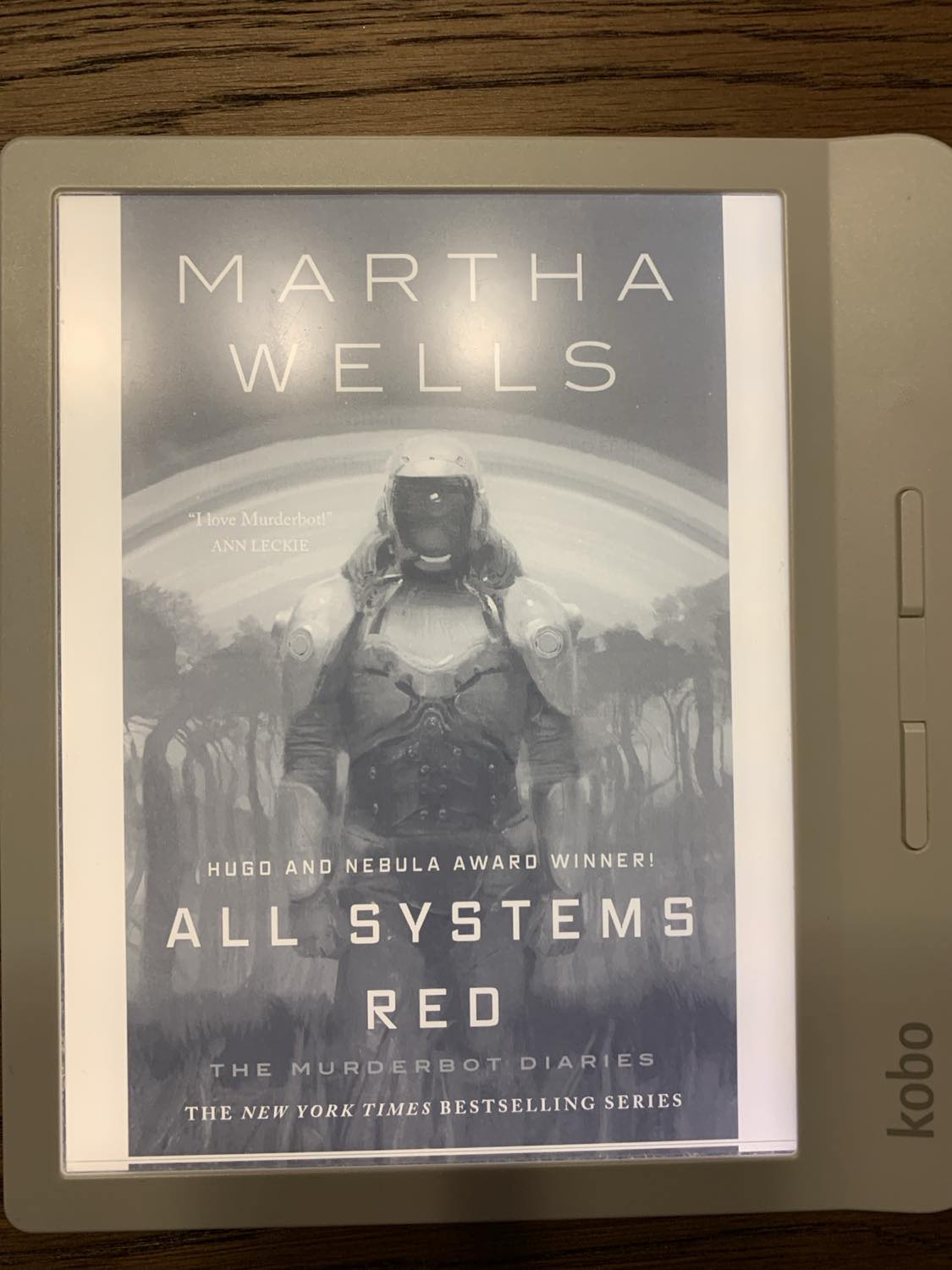
All Systems Red (The Murderbot Diaries, book 1) – Martha Wells

I could have become a mass murderer after I hacked my governor module, but then I realized I could access the combined feed of entertainment channels carried on the company satellites. It had been well over 35,000 hours or so since then, with still not much murdering, but probably, I don’t know, a little under 35,000 hours of movies, serials, books, plays, and music consumed. As a heartless killing machine, I was a terrible failure.

The novella is about a cyborg, in a distant future, designed to protect humans as a security unit, but which becomes independent from its programming. Having the option to do basically anything, the cyborg (which calls itself Murderbot) decides to spend its time watching soap operas. However, circumstances (as it was escorting a research team on an unexplored, but habitable planet) make Murderbot to care more about humans than it previously considered and move it from its languor.

The book is narrated as first person by the cyborg, hence the title of The Murderbot Diaries. In a close to detective story, it explores the journey from indifference to caring for people, . However, the journey is done in a light and funny way, full doubts and timidity.

What impresses, besides the compelling storytelling and great writing, is the world development. We are in a futuristic world dominated by corporations that push the boundaries of humanity. The travel is by wormhole, but the author doesn’t lose words into describing the technologies. They are just there, doing a function, and they naturally feel familiar. The narrator doesn’t need to describe them, which makes the story very fluid.

The novella was widely acclaimed in the science fiction literature. In this genre, there are two major honours, the Nebula and Hugo Awards. The novella from Martha Wells won both awards for best novella, an impressive accomplishment.

The book is the first in the series, the Murderbot diaries, currently having six novellas and a full-length novel. Clearly an entertaining series and a great, relaxing read on a rainy evening.

Light Bringer (Red Rising saga: Book 6) – Pierce Brown

If we demand restitution for all the evils that have been done to us, there will be no end to this war. It will consume us and the people we claim to lead. The future is more important than our wounds… The purpose of war must not be vengeance. It cannot be to kill your enemies until none are left. That is barbarism. That’s how Earth and its multitude of nations strangled itself… The purpose of war must be to find the road back to peace.

The penultimate book of the saga puts again Darrow at the center of the Red Rising, this time fighting in the distant Rim to find allies for the losing battle on Mars. The book is presented from several point of views, following different characters, but ultimately tracing the protagonist’s adventures.

Once again, the author, Pierce Brown, created a believable plot with unexpected turns, memorable characters and an immersing world, with beautiful prose and dialogues. It is a very long book, but the reader, particularly the fans, do not feel bored at any moment. No description or dialogues feel superfluous. While being the 6th book in the series, the book can be read as a standalone.

What stands apart for Red Rising saga is the masterful plot and story-line: the characters make plans and take rational decisions, well explained by the author. The world is big and not resumed to a few main characters. There is imperfect information than the protagonists must accept in taking the decisions. Some situations have only bad solutions, and there is no magic to save the day.

The beautiful prose, excellent editing and well-thought motivations of characters make the reading very fluid and engaging. The vocabulary used is pertinent and novel, and the dialogues or descriptions do not look dragged out. The author masterfully finds the balance between giving enough text to explain a situation or a scene, but not too much to make it tedious.

The saga is truly captivating, once the reader accepts early on the world building: a human Society that expanded across our solar system, based on a pyramid of power, where the different layers are genetically engineered to do their jobs, without the possibility of social mobility between social classes. The Golds will always rule and the Browns will always be janitors. The Reds, at the base of the pyramid, are the lowest of the workers. However, the injustice and the keen observation that the human civilization stagnated in this socioeconomic organization ignite a revolution, started by a few Golds with a sense of justice, but really supported by many talents from the other social classes. Here comes Darrow, a Red transformed in a Gold, that has the talent to start the revolution and upturn the Society.

The range of characters and their deep motivations make many readers to invest emotionally in them: from the fiery Virginia that has to be more calculating and cold as a Sovereign of the Republic, to Sevro, a family man that has to fight dirty to ensure his family’s survival.

A beautiful saga, with an unpredictable plot, great actions scenes, characters with deep motivations, superb storytelling and thoughtful dialogues.

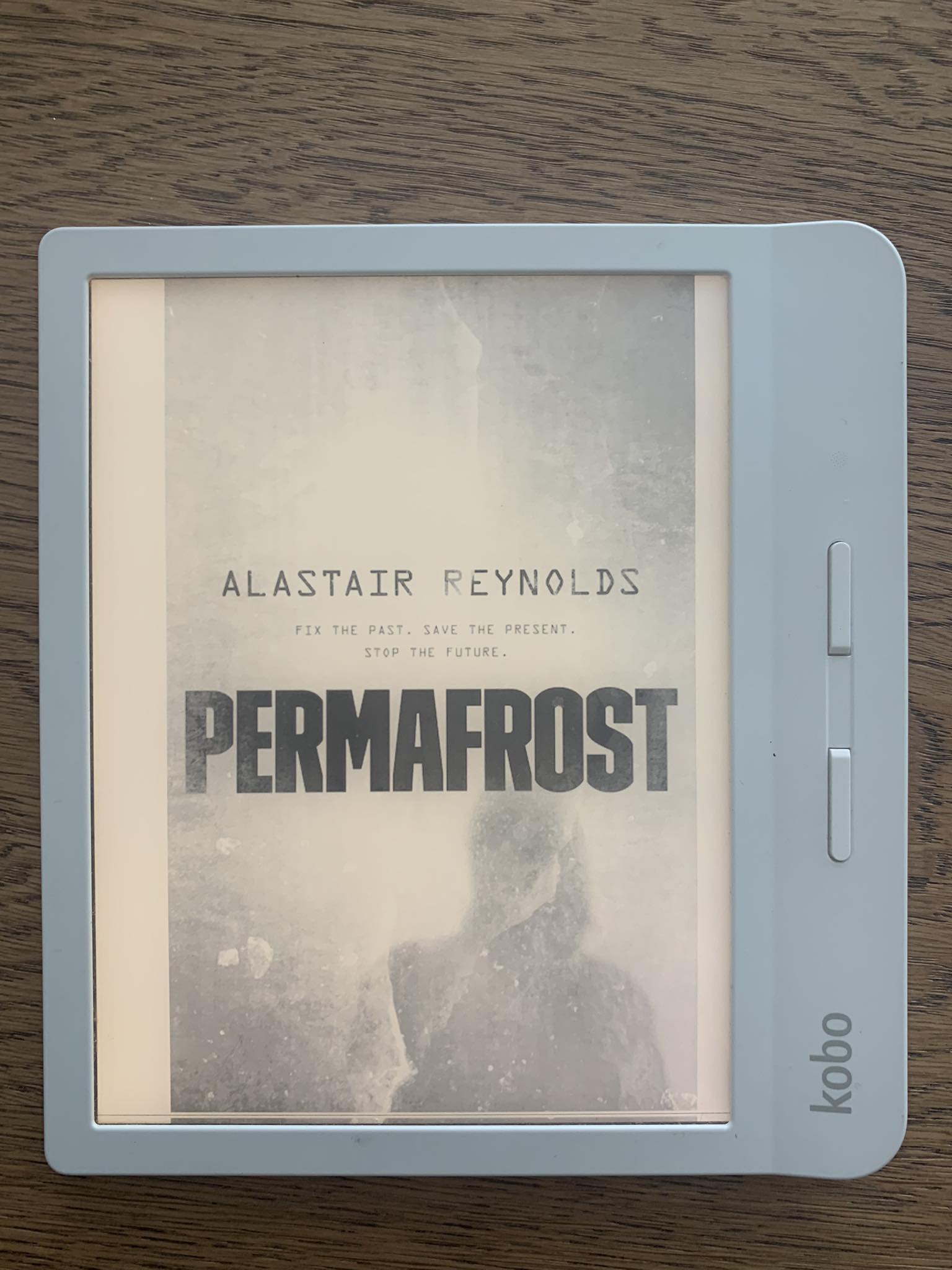
Permafrost – Alastair Reynolds

Time wasn’t a river, she said, and it wasn’t a circuit-diagram. Nor was it a tree with multiple branches. It was a block structure, more like a crystal lattice than any of those old dead-end paradigms. It was a lattice that spanned the entire existence of the universe, from beginning to end. There were no alternate histories, no branches where the Roman empire never fell or the dinosaurs were never wiped out. Just that single lattice, a single fixed structure. We were in it, embedded in its matrix.

The novella by the praised Welsh author Alastair Reynolds explores the theme of time traveling, looking at retro-causality (an effect precedes its cause in time) and grandfather paradox (a cause is eliminated by its own effect and so preventing its own cause). The world is on the brink of disaster in 2080, due to a virus that gradually infects different species of insects, killing them. The effect is the fall of crops and collapse of environmental chains. In this life-ending world, humanity desperately tries new, dangerous solutions, the main project being time-traveling. However, the limits of what can be done in the past are well understood and limited by the traveling technology itself.

While only a short story, the book is grappling the reader with its immersive plot and, as usual from Alastair Reynolds, the science is well-researched. There is no magic bullet or perfect protagonist. This makes the story credible, mature and thought-provoking.

Alastair Reynolds is a prodigious author and scientist, with a PhD in astrophysics from the University of St Andrews and worked for the European Space Agency. His books are dealing with science fiction, particularly a branch of the genre called hard scifi, meaning a concern for scientific accuracy and logic.

The title of the book is slightly misleading in my opinion, as the concepts explored in the book are not really dealing with a world of ice, but with time traveling, forced as a potential solution by an ecological disaster.

Nevertheless, overall, a good, thoughtful, grappling short book by a master of hard scifi.

Captain Alatriste – Arturo Pérez-Reverte, Carlota Pérez-Reverte, (Translator Margaret Sayers Peden)

He was not the most honest or pious of men, but he was courageous. His name was Diego Alatriste y Tenorio, and he had fought in the ranks during the Flemish wars. When I met him he was barely making ends meet in Madrid, hiring himself out for four maravedís in employ of little glory, often as a swordsman for those who had neither the skill nor the daring to settle their own quarrels. You know the sort I mean: a cuckolded husband here, outstanding gambling debts there, a petty lawsuit or questionable inheritance, and more troubles of that kind. It is easy to criticize now, but in those days the capital of all the Spains was a place where a man had to fight for his life on a street corner lighted by the gleam of two blades.

The book is a cloak and dagger novel, first in a series called “The adventures of Captain Alatriste”. We follow the protagonist’s story, presented mostly by his young page, in first person. The book is short and elegant, beautifully setting up the atmosphere of Madrid at the beginning of the 17th century (the story happens in the 1620s).

The plot is simple and the actions scenes are rare, the prose generally being concerned of presenting the Madrid in Spain’s golden century, with an air of melancholy, beautiful poems and introducing the language of the era. While it feels that it copies the story of the French musketeers of Dumas, it has a distinct plot and a superb setting up of the world.

The book reads for me like a young adult novel, with the simple plot and swashbuckling captain, who is, of course, a man of few words and invincible in sword combat. Nevertheless, the Spanish prose feels so well constructed that transpires even with an English translation. It has one of the best beginnings of a book, where we learn from the first phrases who are we dealing with and how it is going. It is a book that makes you want to learn Spanish, just to read it in original. One of the best pieces of Spanish literature, in my opinion.

Overall, a beautiful presentation of Madrid at the beginning of the Iberian empire’s golden century, a skillful prose that make you learn the original language and an introduction to the adventures of a memorable (fictional) Spanish soldier.

Project Hail Mary – Andy Weir

Oh thank God. I can’t imagine explaining “sleep” to someone who had never heard of it. Hey, I’m going to fall unconscious and hallucinate for a while. By the way, I spend a third of my time doing this. And if I can’t do it for a while, I go insane and eventually die. No need for concern.

The book follows the story of the sole survivor of a human crew in their interstellar voyage to find a cure for the microbes that infect the sun and threaten the future of humanity. The narrative is a mix of hard science fiction with comedy.

What a book! For hard science fictions fans this is an almost perfect combination of hard astronomy and physics lessons, a very credible plot, humour, aliens and survival in space. I could not leave the book from my hands.

The story starts with an unexpected dimming of the sun that quickly is determined to be by an infection with some mysterious microbes that simply take energy from the sun and then travel to the highest carbon dioxide-heavy planet (it’s not Earth) to reproduce, return to the sun and restart the cycle. On the other hand, the microbes store immense energy, which changes all interstellar travel paradigm. The dimming of the sun will have rather quickly catastrophic effects on Earth, in only a few decades. All stars around our solar system dim, except one.

A crew is quickly assembled to find if this star has any solutions to Earth’s problems, but only our protagonist survives. And the quest begins.

What is most engaging in this book is that there is no secret recipe, no luck involved, just hard work and using existing tools offered by science and environment. Problems come one after another, but through determination and team work, they are gradually resolved.

A superb book by the author of “The Martian”! I really enjoyed it.

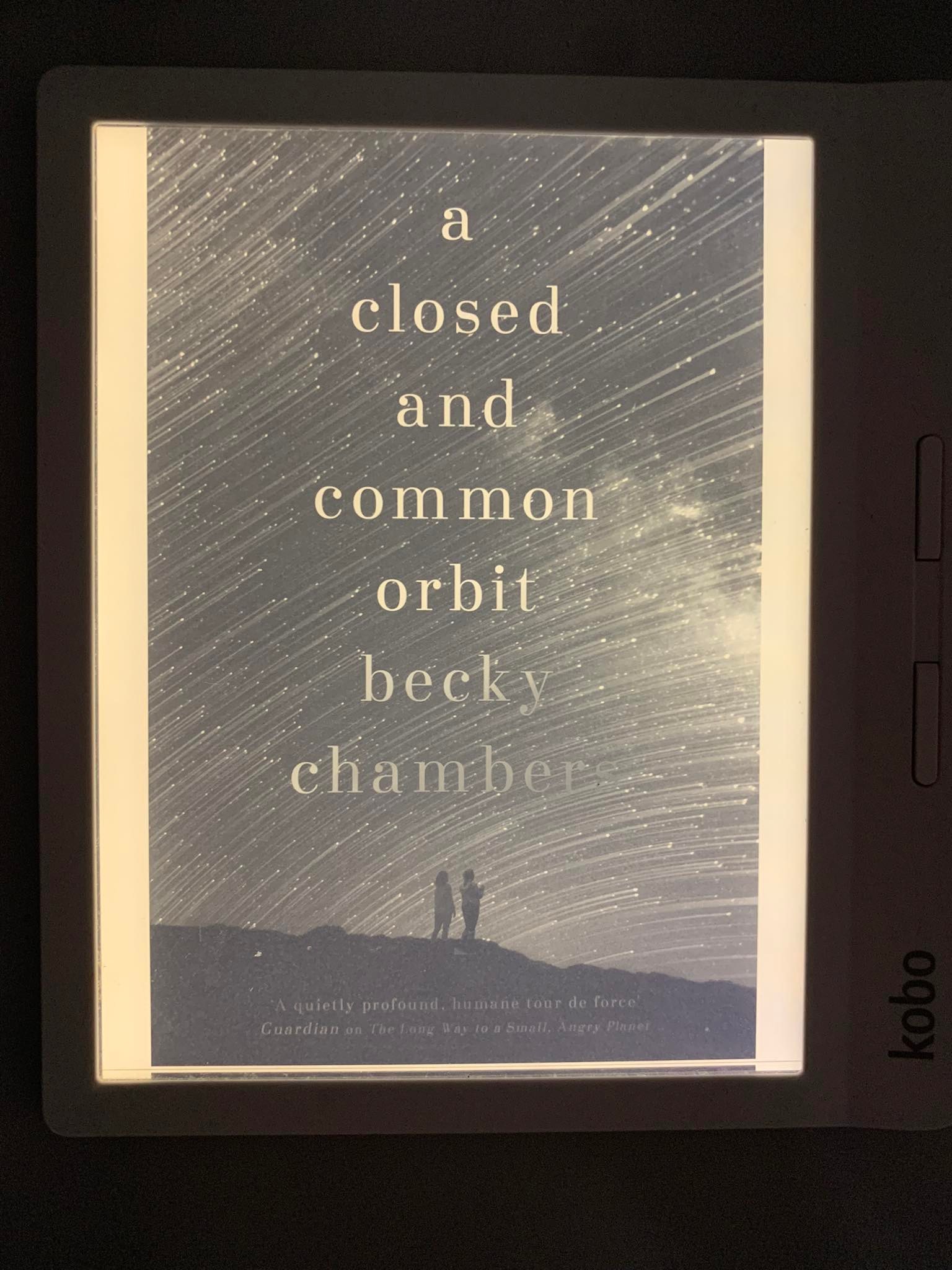
A Closed and Common Orbit (Wayfarers Book 2) – Becky Chambers

What was the difference between strung-together neurons and a simple bundle of if/then code, if the outward actions were the same? Could you say for certain that there wasn’t a tiny mind in that bot, looking back at the world like a beetle might?

The book presents in two separate, but interlinked stories, the survival and friendship adventures of an artificial intelligence (AI) and a clone on the run, sometime in the far future. A Close and Common Orbit is the stand-alone second book of the Wayfarers series.

The impressive world-building and memorable characters remain the strong-points of the series, but this time the story goes in a new direction compared with the first book. If the first book followed a motley crew, this volume is more about personal discovery, grit and friendship. The author explores the consciousness of an AI and how it evolves and interacts with sapient organics, through two separate stories (will not spoil how they are linked).

The book is captivating and fulfilling in its climax, with a good pace, creating a rich world, but unburdened by long descriptions. It is excellent storytelling. The plot is rather straightforward, but the introspection of the main characters makes a fascinating read.

An AI and a clone on the run, in two separate, but interlinked stories.

The author, Becky Chambers, is a well recognized and award-winning sci-fi writer, and these were the books that made her fame, the Wayfarers series being her most accoladed prose so far.

Overall, the second book of the series is an engaging and captivating read that has plenty of food for thought.

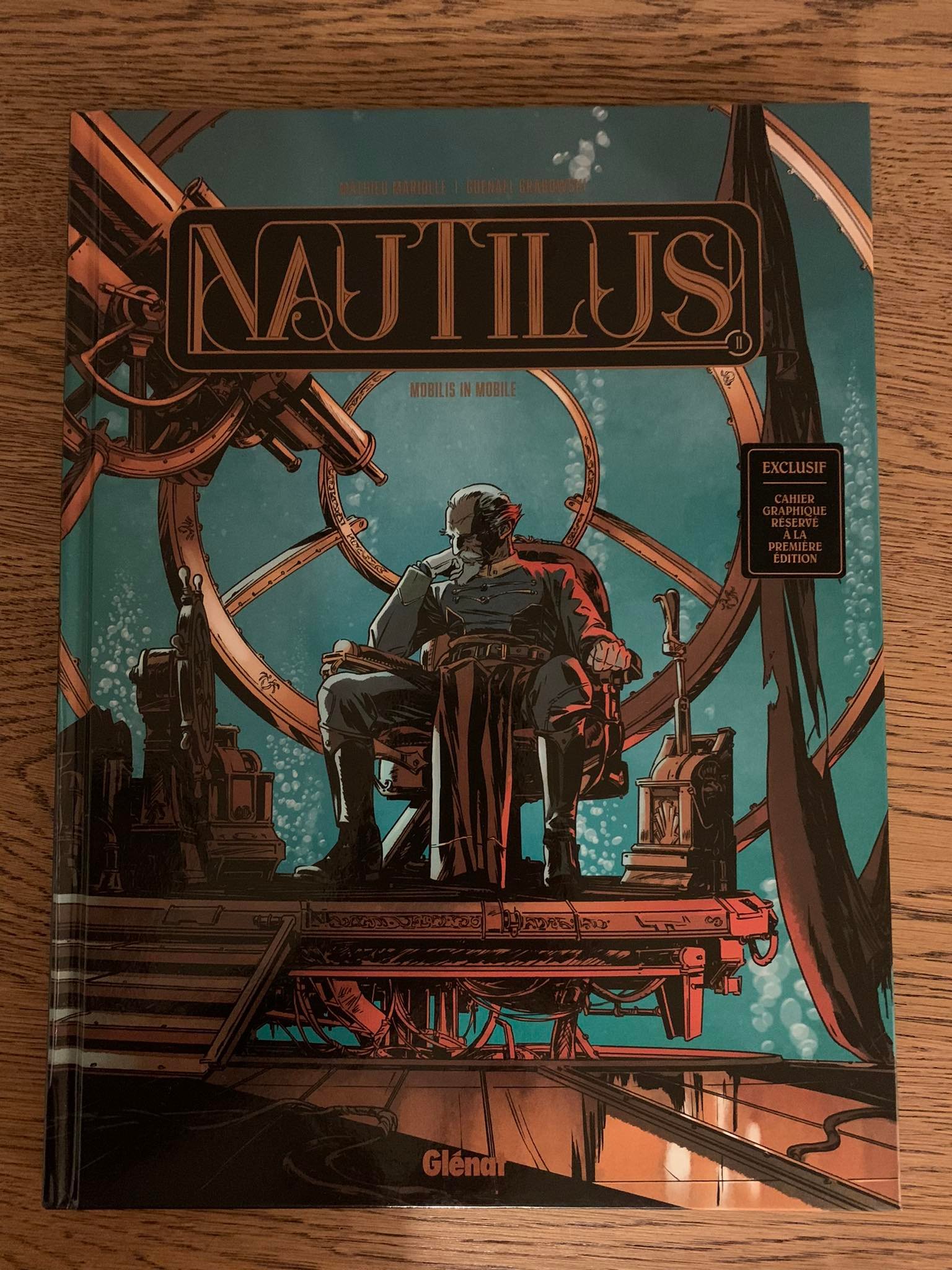
Nautilius (Tome 2) – Mathieu Mariolle, Guénaël Grabowski

Tout en se faisant passer pour un agent du gouvernement français du nom de Jean Paillole, Kimball parvient à faire évader Némo de la prison russe qui le retenait depuis plus de 10 ans. Avec son capitaine libéré, le légendaire Nautilus est prêt à se diriger vers la baie de Bombay où reposent toujours les documents que Kimball convoite tant. Le temps presse, l’évasion de Némo à fait grand bruit et Kimball est toujours suivi à la trace. Pourtant, le submersible n’a pas encore démarré que le ton monte entre les deux hommes. S’ils veulent s’en sortir, il devront rester soudés… Mais les dissenssions sont à chaque instant plus flagrantes. Une question reste alors en suspens : lequel trahira l’autre en premier ? Deuxième partie d’un triptyque haletant, veritable course poursuite à l’échelle planétaire où se mêlent espionnage, situations inextricables et scènes spectaculaires, Nautilus continue de proposer un récit beau et palpitant.

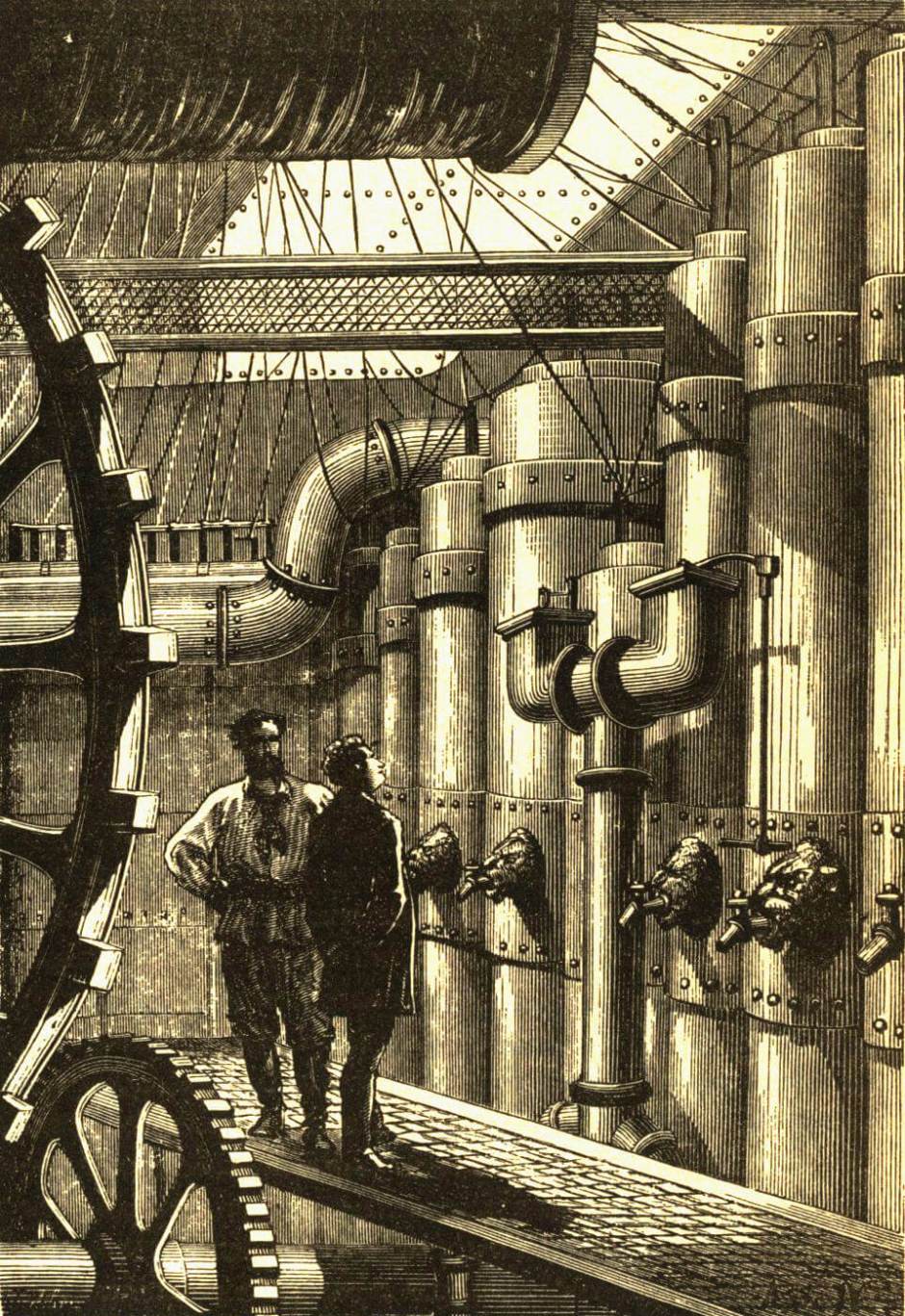
Le volume est une nouvelle prise du légendaire capitaine Nemo et de son submersible, Nautilus (créé par le romancier français Jules Verne), dans un monde du 19ème siècle où les submersibles sont encore une merveille. Danse le deuxième tome de la trilogie, le capitaine Nemo est sauvé de prison par Kimball, un homme qui veut prouver son innocence avec des documents d’un épave au fond du golfe du Bengale. Ainsi, le submersible est un élément clé de sa quête ; mais pour une raison quelconque, il pose comme agent du gouvernement français.

L’histoire de Mathieu Mariolle est bien écrite et la meilleure partie est la profondeur des principaux protagonistes, qui sont bien conçus et leurs motivations sont claires. J’ai particulièrement apprécié les dessins, qui sont de petites œuvres d’art. Le dessinateur, Guénaël Grabowski, a le sens des couleurs et des détails. Le lecteur peut ressentir les sentiments complexes des personnages dans ses dessins. Aussi, le lecteur peut voir la grandeur du Nautilus et le savant fou du capitaine Nemo.

Les aventures du capitaine Nemo et de sa merveille d’ingénierie, le submersible Nautilus, dans un monde rempli d’intrigues et d’espionnage.

J’ai apprécié le volume et les dessins magistraux. Une super série, j’attends avec impatience le tome 3 !

Colonisation (Tome 6) – Denis-Pierre Filippi, Vincenzo Cucca

Les équipes de l’Agence ont été attaquées. Une branche indépendante d’Écumeurs dirigée par un certain Raylan est parvenue à s’infiltrer dans le vaisseau du Commodore Illiatov. Leur assaut, s’il était destiné à la récolte de données concernant les nefs perdues, ne sera parvenu qu’à une chose : mettre fin à la vie de nombreux agents et notamment à celle du Commodore lui-même. Raylan et ses sbires sont en fuite et mènent la danse, agissant toujours avec un coup d’avance. La menace s’intensifie, les morts se multiplient et l’escouade de Milla réalise peut-être trop tard que l’ennemi qui lui fait face est le plus rusé et le plus redoutable qu’elle ait jamais eu à affronter.

Colonisation est le 6ème tome de la série des bandes dessinées par scénariste Denis-Pierre Filippi et dessinateur Vincenzo Cucca. Les dessins et le scénario sont captivants et clairement profondément pensés. La série est imaginative et pleine d’action. Les inconvénients sont le manque de science dure à certains moments, comme aller sur une planète extraterrestre dangereuse (haut de gamme) par l’équipe de recherche sans casque.

Le context de l’histoire est l’humanité dans le futur, envoyant des colonies dans le grand espace. Cependant, des extraterrestres bien intentionnés offrent à l’humanité le cadeau de voyager vite dans l’espace. Les colonies sont un prix élevé du marché noir et l’Agence est formée, pour trouver et protéger des braconniers maléfiques ces colonies perdues. La série suit les aventures de l’agence dans sa mission de défendre les colonies humaines perdues.

Dans ce volume 6, l’Agence tente de capturer un braconnier habile appelé Raylene, qui s’avère plus ingénieux et impitoyable que prévu.

Défendre les colonies humaines perdues contre les braconniers maléfiques dans le futur lointain de l’humanité.

Le volume était captivant et les dessins capturaient magnifiquement l’immensité de l’espace et de l’humanité dans le futur. Si l’histoire est forte, les dialogues sont moins forts que les illustrations, qui sont vraiment mémorables. Les scènes d’action et l’histoire elle-même sont bien mises en page et facilitent la lecture et le suivi de l’action pour le lecteur.

Dans l’ensemble, même si elle manque parfois de science dure, la série est captivante et avec des illustrations mémorables.

Absolution gap (Revelation Space Book 3)- Alastair Reynolds

“When two or more of their lighthuggers met, they would compare and update their respective nomenclature tables. If the first ship had assigned names to a group of worlds and their associated geographical features, and the second ship had no current entries for those bodies, it was usual for the second ship to amend its database with the new names. They might be flagged as provisional, unless a third ship confirmed that they were still unallocated.”

A meandering, long and unexpected finish for the Revelation Space series. The characters from the last chapter are still followed by the Inhibitors, the civilization hunters and destroyers, but a mysterious, disappearing planet could give key answers.

Towering at almost 700 pages, this hard scifi book still comes with intriguing and though-provoking ideas, such as moving cathedrals, Gothic spaceships, religious viruses and many more. However, the changes seem more of style than substance, at least compared with the previous books.

It was an entertaining book and, despite its length and a falling flat ending, the writing, editing, vocabulary remained great.

The fight against the Inhibitors begins.

Redemption Ark (Revelation Space Book 2) – Alastair Reynolds

Is that what happened to Mercier?” “No—not quite. In so far as I understood Sukhoi’s work, it appeared that the zero-mass state would be very difficult to realise physically. As it neared the zero-mass state, the vacuum would be inclined to flip to the other side. Sukhoi called it a tunnelling phenomenon.” Clavain raised an eyebrow. “The other side?” “The quantum-vacuum state in which matter has imaginary inertial mass. By imaginary I mean in the purely mathematical sense, in the sense that the square root of minus one is an imaginary number. Of course, you immediately see what that would imply.” “You’re talking about tachyonic matter,” Clavain said. “Matter travelling faster than light.
This is the second book in the Revelation Space trilogy, following the first book with the same title, and one of the books from the Revelation Space universe.

Humanity in 26th century achieves a level of space traveling and technological development which triggers ancient machines called Inhibitors designed to detect and eliminate intelligent life. Inhibitors have their own, well thought reasons to these purges. They are not mindless, evil machines, but instruments intended to preserve life in the long term.

The plot follows the search for several doomsday weapons hidden on a lighthugger, the name for human spacefaring ships. The protagonist, Clavain, is a bit of an old maverick, crossing between human factions.

The book explores the question of why we are alone in the universe despite having a rather middle aged galaxy. The book and the overall series is an extremely well thought and well written universe. While the plot is good, but not exceptional, the profoundness of technological development and realism of astrophysical phenomena is astounding. This is an exceptional hard sci-fi and I am puzzled why it was not nominated for any sci-fi prizes.

As in the previous book, the vocabulary used is gargantuan, making it an educational reading, including a good introduction in astrophysics. Even more impressive, the wording is not hindering the pace of the story, which makes the novel a beautiful crafted and immersive reading.

On the downside, the length of the book is rather excessive and some more limitations on technology could be envisaged.

Overall, this is a fantastic hard sci-fi novel.