Statecraft – Margaret Thatcher

The West as a whole in the early 1990s became obsessed with a ‘peace dividend’ that would be spent over and over again on any number of soft-hearted and sometimes soft-headed causes. Politicians forgot that the only real peace dividend is peace.

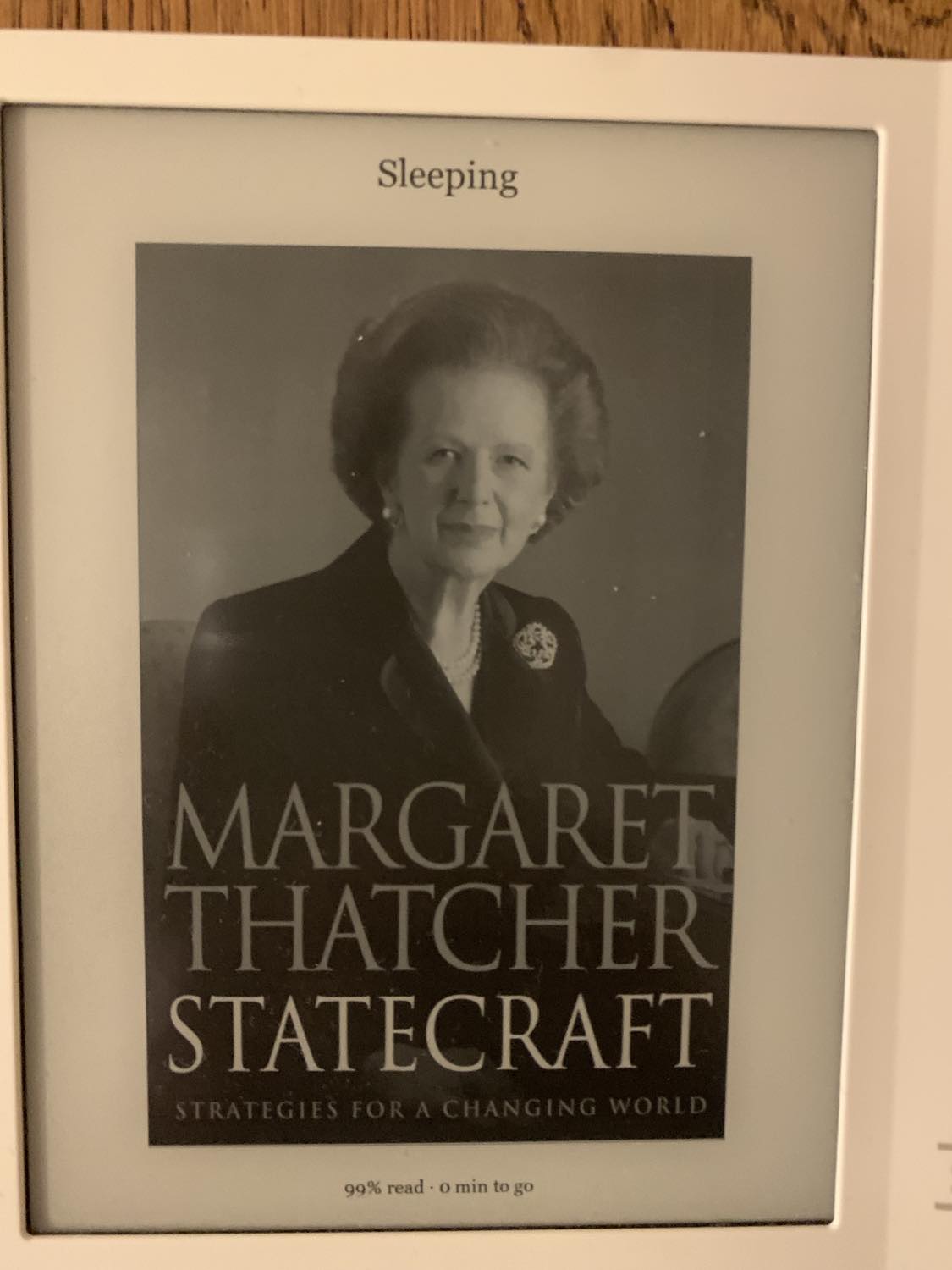
The book is an analysis of the international affairs by the former British Prime Minister, Margaret Thatcher. The book’s chapters are organized geographically, by country or region, but they also have some chapters on the fundamentals of classical liberalism. The analysis aims to guide and advise young politicians on a continuously changing world.

Strongly opinionated, Thatcher argues vigorously for free markets, strong military, prosperous economy, freedom of choice, limited state intervention, rule of law and British exceptionalism. What made Thatcher impressive was her 3 consecutive won elections, despite tough social measures.

The book is from 2002 and appears, in some respect, outdated. However, in many ways, the former Prime Minister was spot on in her analysis of the trends: the autocratic nature of Russia, the prosperity that free markets will bring to China, the bureaucratic European Union, the allure of social measures and strength and enterprise of the United States of America.

The volume is quite long and dense, but every chapter has at the end several main points, highlighted in a bullet-point, bold format, which makes the reading easier. many of her speeches are quoted in the book, but they are well inserted and the book is not just a collection of speeches.

While reading the book, I found myself wondering how many people will actually vote for her today. She combined a strong leader, with clear views, a well organized politician, a woman in a world of mostly men and a conservative liberal in one person. It is interesting that conservative parties, which do not have any gender quotas, but rather look at merit, brought forward most world prime ministers, to what I can remember.

I enjoyed the book, it was entertaining and timeless, pensive, intriguing at times, strong in both criticism and defending the values that she stood for. She must have been a truly remarkable stateswoman.

Light Bringer (Red Rising saga: Book 6) – Pierce Brown

If we demand restitution for all the evils that have been done to us, there will be no end to this war. It will consume us and the people we claim to lead. The future is more important than our wounds… The purpose of war must not be vengeance. It cannot be to kill your enemies until none are left. That is barbarism. That’s how Earth and its multitude of nations strangled itself… The purpose of war must be to find the road back to peace.

The penultimate book of the saga puts again Darrow at the center of the Red Rising, this time fighting in the distant Rim to find allies for the losing battle on Mars. The book is presented from several point of views, following different characters, but ultimately tracing the protagonist’s adventures.

Once again, the author, Pierce Brown, created a believable plot with unexpected turns, memorable characters and an immersing world, with beautiful prose and dialogues. It is a very long book, but the reader, particularly the fans, do not feel bored at any moment. No description or dialogues feel superfluous. While being the 6th book in the series, the book can be read as a standalone.

What stands apart for Red Rising saga is the masterful plot and story-line: the characters make plans and take rational decisions, well explained by the author. The world is big and not resumed to a few main characters. There is imperfect information than the protagonists must accept in taking the decisions. Some situations have only bad solutions, and there is no magic to save the day.

The beautiful prose, excellent editing and well-thought motivations of characters make the reading very fluid and engaging. The vocabulary used is pertinent and novel, and the dialogues or descriptions do not look dragged out. The author masterfully finds the balance between giving enough text to explain a situation or a scene, but not too much to make it tedious.

The saga is truly captivating, once the reader accepts early on the world building: a human Society that expanded across our solar system, based on a pyramid of power, where the different layers are genetically engineered to do their jobs, without the possibility of social mobility between social classes. The Golds will always rule and the Browns will always be janitors. The Reds, at the base of the pyramid, are the lowest of the workers. However, the injustice and the keen observation that the human civilization stagnated in this socioeconomic organization ignite a revolution, started by a few Golds with a sense of justice, but really supported by many talents from the other social classes. Here comes Darrow, a Red transformed in a Gold, that has the talent to start the revolution and upturn the Society.

The range of characters and their deep motivations make many readers to invest emotionally in them: from the fiery Virginia that has to be more calculating and cold as a Sovereign of the Republic, to Sevro, a family man that has to fight dirty to ensure his family’s survival.

A beautiful saga, with an unpredictable plot, great actions scenes, characters with deep motivations, superb storytelling and thoughtful dialogues.

Ghost Fleet: A Novel of the Next World War – P.W. Singer, August Cole

He compared the intelligence task to solving a jigsaw puzzle, except that you didn’t get the box cover, so you didn’t know what the final picture was. And you got only a few pieces at a time, not all of them. And even worse, you always got a bunch of pieces from some other puzzle thrown in.

The book hypothesizes about an invasion of United States, namely Hawaii, by China in near future. While the concept is great and well researched, the story itself is highly dramatized, mostly following personal stories of some characters in Hawaii (Chinese, Russian and American) and the patching, development and fighting of a US warship (with an unique gun) and several of its crew. The book is full of drama and action, with many overlapping stories.

The strength of the book is the initial concept of China invading US, the actual tactics used and the immediate strategic consequences. This indeed is food for thought and a unique selling point. The tactics refer to how to actually bring troops to the US islands, neutralize the naval and air force, and all the logistics that make US formidable. A tall order, but the authors have well reasoned responses to this task.

The title of the book comes from the idea that mothballed, old ships (the Ghost fleet) are reinstated into service and bring much relief to the decimated US forces. However, except the story of one such ship, which is more or less, followed throughout the book, no much is mentioned about these ships.

There is little discussed by the authors in terms of overview developments following the invasion and even the US counterattack is left in limbo in terms of conclusions. We know nothing of how it ended, which feels like the book is missing a intermediary chapter.

Nevertheless, the book is exceptionally well-researched for correct military vocabulary, latest war machines and tactics. It gives a glimpse into contemporary lines of military technique.

It was an engaging book, but it felt quite a downfall in intellectual quality after the initial chapters. Nevertheless, it managed to keep me reading until the end.

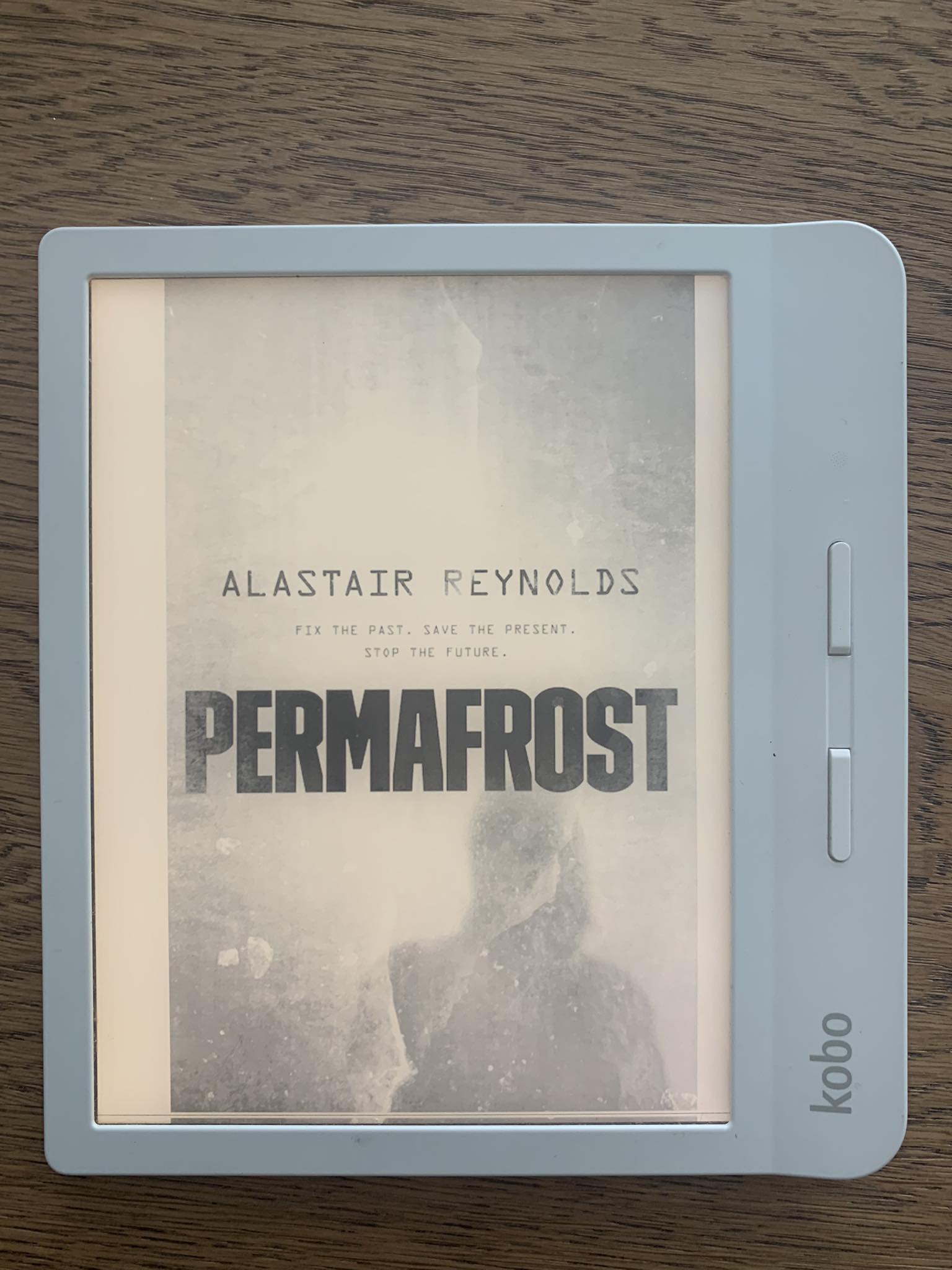
Permafrost – Alastair Reynolds

Time wasn’t a river, she said, and it wasn’t a circuit-diagram. Nor was it a tree with multiple branches. It was a block structure, more like a crystal lattice than any of those old dead-end paradigms. It was a lattice that spanned the entire existence of the universe, from beginning to end. There were no alternate histories, no branches where the Roman empire never fell or the dinosaurs were never wiped out. Just that single lattice, a single fixed structure. We were in it, embedded in its matrix.

The novella by the praised Welsh author Alastair Reynolds explores the theme of time traveling, looking at retro-causality (an effect precedes its cause in time) and grandfather paradox (a cause is eliminated by its own effect and so preventing its own cause). The world is on the brink of disaster in 2080, due to a virus that gradually infects different species of insects, killing them. The effect is the fall of crops and collapse of environmental chains. In this life-ending world, humanity desperately tries new, dangerous solutions, the main project being time-traveling. However, the limits of what can be done in the past are well understood and limited by the traveling technology itself.

While only a short story, the book is grappling the reader with its immersive plot and, as usual from Alastair Reynolds, the science is well-researched. There is no magic bullet or perfect protagonist. This makes the story credible, mature and thought-provoking.

Alastair Reynolds is a prodigious author and scientist, with a PhD in astrophysics from the University of St Andrews and worked for the European Space Agency. His books are dealing with science fiction, particularly a branch of the genre called hard scifi, meaning a concern for scientific accuracy and logic.

The title of the book is slightly misleading in my opinion, as the concepts explored in the book are not really dealing with a world of ice, but with time traveling, forced as a potential solution by an ecological disaster.

Nevertheless, overall, a good, thoughtful, grappling short book by a master of hard scifi.

Captain Alatriste – Arturo Pérez-Reverte, Carlota Pérez-Reverte, (Translator Margaret Sayers Peden)

He was not the most honest or pious of men, but he was courageous. His name was Diego Alatriste y Tenorio, and he had fought in the ranks during the Flemish wars. When I met him he was barely making ends meet in Madrid, hiring himself out for four maravedís in employ of little glory, often as a swordsman for those who had neither the skill nor the daring to settle their own quarrels. You know the sort I mean: a cuckolded husband here, outstanding gambling debts there, a petty lawsuit or questionable inheritance, and more troubles of that kind. It is easy to criticize now, but in those days the capital of all the Spains was a place where a man had to fight for his life on a street corner lighted by the gleam of two blades.

The book is a cloak and dagger novel, first in a series called “The adventures of Captain Alatriste”. We follow the protagonist’s story, presented mostly by his young page, in first person. The book is short and elegant, beautifully setting up the atmosphere of Madrid at the beginning of the 17th century (the story happens in the 1620s).

The plot is simple and the actions scenes are rare, the prose generally being concerned of presenting the Madrid in Spain’s golden century, with an air of melancholy, beautiful poems and introducing the language of the era. While it feels that it copies the story of the French musketeers of Dumas, it has a distinct plot and a superb setting up of the world.

The book reads for me like a young adult novel, with the simple plot and swashbuckling captain, who is, of course, a man of few words and invincible in sword combat. Nevertheless, the Spanish prose feels so well constructed that transpires even with an English translation. It has one of the best beginnings of a book, where we learn from the first phrases who are we dealing with and how it is going. It is a book that makes you want to learn Spanish, just to read it in original. One of the best pieces of Spanish literature, in my opinion.

Overall, a beautiful presentation of Madrid at the beginning of the Iberian empire’s golden century, a skillful prose that make you learn the original language and an introduction to the adventures of a memorable (fictional) Spanish soldier.

Children of Time – Adrian Tchaikovksy

There had been those back on Earth who claimed the universe cared, and that the survival of humanity was important, destined, meant . They had mostly stayed behind, holding to their corroding faith that some great power would weigh in on their behalf if only things became so very bad. Perhaps it had: those on the ark ship could never know for sure. Holsten had his own beliefs, though, and they did not encompass salvation by any means other than the hand of mankind itself.

This science fiction book is a grappling story of a race for survival for humanity, escaping a poisoned Earth, in an ark traveling the stars towards a new home. The terraforming process that the old, tech advanced Earth has started elevates a species to unprecedented cognitive levels. The human, ark-traveling, last refugees and the legacy of old Earth are heading for a clash.

Children of Time started the series with the homonym name. The book, from 2015, is widely acclaimed and was awarded the Arthur C Clarke book prize.

The themes explored by the author Adrian Tchaikovsky, alienness, star travel, species evolution, disaster, artificial intelligence, survival, cryo sleep, display profound thinking of how these themes may occur in the future and what would be the effects.

A gem of classic science fiction literature.

Well-paced plot, fluid writing, memorable characters, an engaging story, an unpredictable plot and profound themes explored – make the ingredients of a milestone setting book. A truly enjoyable and captivating read, on par with Alaistair Reynolds and Kim Stanley Robinson.

[Cover photo by AndreyC called River on Pixabay.]

Project Hail Mary – Andy Weir

Oh thank God. I can’t imagine explaining “sleep” to someone who had never heard of it. Hey, I’m going to fall unconscious and hallucinate for a while. By the way, I spend a third of my time doing this. And if I can’t do it for a while, I go insane and eventually die. No need for concern.

The book follows the story of the sole survivor of a human crew in their interstellar voyage to find a cure for the microbes that infect the sun and threaten the future of humanity. The narrative is a mix of hard science fiction with comedy.

What a book! For hard science fictions fans this is an almost perfect combination of hard astronomy and physics lessons, a very credible plot, humour, aliens and survival in space. I could not leave the book from my hands.

The story starts with an unexpected dimming of the sun that quickly is determined to be by an infection with some mysterious microbes that simply take energy from the sun and then travel to the highest carbon dioxide-heavy planet (it’s not Earth) to reproduce, return to the sun and restart the cycle. On the other hand, the microbes store immense energy, which changes all interstellar travel paradigm. The dimming of the sun will have rather quickly catastrophic effects on Earth, in only a few decades. All stars around our solar system dim, except one.

A crew is quickly assembled to find if this star has any solutions to Earth’s problems, but only our protagonist survives. And the quest begins.

What is most engaging in this book is that there is no secret recipe, no luck involved, just hard work and using existing tools offered by science and environment. Problems come one after another, but through determination and team work, they are gradually resolved.

A superb book by the author of “The Martian”! I really enjoyed it.

A Closed and Common Orbit (Wayfarers Book 2) – Becky Chambers

What was the difference between strung-together neurons and a simple bundle of if/then code, if the outward actions were the same? Could you say for certain that there wasn’t a tiny mind in that bot, looking back at the world like a beetle might?

The book presents in two separate, but interlinked stories, the survival and friendship adventures of an artificial intelligence (AI) and a clone on the run, sometime in the far future. A Close and Common Orbit is the stand-alone second book of the Wayfarers series.

The impressive world-building and memorable characters remain the strong-points of the series, but this time the story goes in a new direction compared with the first book. If the first book followed a motley crew, this volume is more about personal discovery, grit and friendship. The author explores the consciousness of an AI and how it evolves and interacts with sapient organics, through two separate stories (will not spoil how they are linked).

The book is captivating and fulfilling in its climax, with a good pace, creating a rich world, but unburdened by long descriptions. It is excellent storytelling. The plot is rather straightforward, but the introspection of the main characters makes a fascinating read.

An AI and a clone on the run, in two separate, but interlinked stories.

The author, Becky Chambers, is a well recognized and award-winning sci-fi writer, and these were the books that made her fame, the Wayfarers series being her most accoladed prose so far.

Overall, the second book of the series is an engaging and captivating read that has plenty of food for thought.

Odyssey One: Into the Black (Odyssey One, book 1) – Evan Currie

A soldier’s first duty, his reason for being, is not to fight. Fighting is the final recourse for any civilized people. His duty is not even to preserve the peace; that is a police officer’s job,” Comdr. Stephen Michaels of the NAC military said by rote, remembering the many long nights of arguments and discussions that had brought this to his mind. “A soldier’s first duty is simply to stand between his nation and any who might wish it harm.

The book follows the voyage of the first interstellar human ship, more of a warship than an explorer. The first star visited outside our solar system triggers a chain reaction driving the ship to new and exciting adventures, discovering new aliens and technologies.

The book is a heavy military scifi, looking at war and fighting from three perspectives: spaceship to spaceship; fighter plane to fighter plane, in space; and futuristic soldiers on new planets. The military theme is heavy throughout the book, the author giving significant thought to what war will look like in several centuries.

From this perspective, the book is a masterpiece, looking deeply of how conflict evolves and the role of the soldier. The world is nicely build around this, creating a believable space saga. From a military perspective, the book is a hard scifi, with an interesting plot and engaging storyline.

On the other hand, the book suffers on the level of personages, which are a bit cliches. They are not truly memorable. We have the wise, heroic and balanced captain; the wacky scientist; the professional and respectful crew; the daring pilots and the merciless aliens. The vocabulary as well could be improved, saying more with less words. The plot has some gaps, it seems unusual for an explorer to go for certain danger without leaving a note from the discoveries. While the author tries to reason the decision taken, it still seems off.

The author, Evan Currie, is a prodigious writer of military scifi and tries hard to create believable and engaging stories with his series of books, the current book (Into The Black) being the first of the series called Odyssey One, which is the name of the exploring ship.

Overall, the book was a relaxing Sunday afternoon reading, which doesn’t pose significant existential questions or substantial moral dilemmas. Nevertheless, for the fans of the genre, it is a an exciting, believable story, with an interesting plot.

The Long Way to a Small, Angry Planet (Wayfarers Book 1) – Becky Chambers

The truth is, Rosemary, that you are capable of anything. Good or bad. You always have been, and you always will be. Given the right push, you, too, could do horrible things. That darkness exists within all of us. You think every soldier who picked up a cutter gun was a bad person? No. She was just doing what the soldier next to her was doing, who was doing what the soldier next to her was doing, and so on and so on. And I bet most of them — not all, but most — who made it through the war spent a long time after trying to understand what they’d done. Wondering how they ever could have done it in the first place. Wondering when killing became so comfortable.

This is the story of a motley crew, specialized in building “tunnels”, the highways of space and their adventures and individual stories. It is feel good science fiction, where bad events happen and there are bad people, but generally things are going well, there is relative stability and a place for everyone, good or bad.

The world building and character creation are the hallmarks of this novel. The world created makes sense and has enormous depth, the author cleverly staying away from introducing more complex concepts that could trigger deep changes in the society. The characters are each followed and given backstories, motivations and clear roles.

The crew is composed of nine entities: captain Ashby Santoso, a human who is keeping others in check; Dr Chef – an alien, both cook and medic, with little ambition other than to please others; Kizzy Shao – human female, the ship’s mechanic and an explosion of energy and words; Jenks – human dwarf, the software expert, literally in love with the ship’s AI; Sissix – an alien part of a species promiscuous by design, ship’s pilot; Artis Corbin – human male, responsible for life systems support and aloof guy; Lovelace – ship’s advanced and sentient AI; Ohan – alien, ship’s navigator, able to calculate faster than AI by plot armour; and Rosemary Harper – human female, and main protagonist, a runner because of her father shameful acts.

Social diversity is the theme of the book: a world less sexist, transphobic and xenophobic. It is so nice that the book feels almost like a young adult novel, with malice in few quantities; a very sugar sweet world.

Despite the relative lack of action and more often than not romantic character building, the book is quite engaging and creates memorable, unique protagonists. It is one of those books that you either love or drop midway. The sequel of the book, A Closed and Common Orbit, was even highly regarded, finalist for the 2017 Hugo Award for Best Novel. Interestingly, the book is a kind of reflection of its real life origins, being initially self-published via a Kickstarter campaign, where about 50 people sponsored the author to continue writing.