The Burnout Society – Byung-Chul Han

Today’s society is no longer Foucault’s disciplinary world of hospitals, madhouses, prisons, barracks, and factories. It has long been replaced by another regime, namely a society of fitness studios, office towers, banks, airports, shopping malls, and genetic laboratories. Twenty-first-century society is no longer a disciplinary society, but rather an achievement society [Leistungsgesellschaft]. Also, its inhabitants are no longer “obedience-subjects” but “achievement-subjects.” They are entrepreneurs of themselves.

The Burnout Society is a philosophical essay calling for humans to, basically, take it easier. Do less, think more. The main message of the book is that the inability to manage negative experiences in a world with too much positivity leads to mental disorders from depression to attention deficit disorder.

The author of the book is the Korean-born German philosopher Byung-Chul Han, who teaches philosophy and cultural studies at Berlin.

Divided into 8 separate chapters, each adopting a separate topic, the book revolves around the pressure to modern individual of the modern society. Why are we so tired and depressed, when we solved, as a society, so many immediate dangers, from illnesses to social safety?

Some chapters I did not like and skipped through, while others where engaging, such as Profound boredom. The chapter had some memorable thoughts: if sleep represents the high point of bodily relaxation, deep boredom is the peak of mental relaxation. A hectic rush produces nothing new, but reproduces what is already available. For example Running is just accelerated walking. Dancing is an entirely new form of motion.

Deep, contemplative attention is inaccessible to the hyperactive ego. Even Nietzsche noted that human life ends in deadly hyperactivity if the contemplative element is taken out. The author takes the example of Paul Cezanne, – who was able to have profound attention (to the landscape).

Another interesting chapter is the one on Vita activa vs vita contemplativa. The message is that we should seek to understand first, before acting. Hyperactivity doesn’t allow free action.

I was not really convinced on the role of contemplation, as reflection felt a better word. In the reflection vs contemplation dichotomy, reflection is active and analytical, while the latter is immersive and passive. What is contemplating without doing?

Overall, the book is intriguing and captures of the main struggles of the modern society. Critics note the fancy language and lack of concrete examples. Supports highlight the depth of thought and the many poignant observations on the pressures of the individual in the modern, atomized, internet-filled and value-missing society.

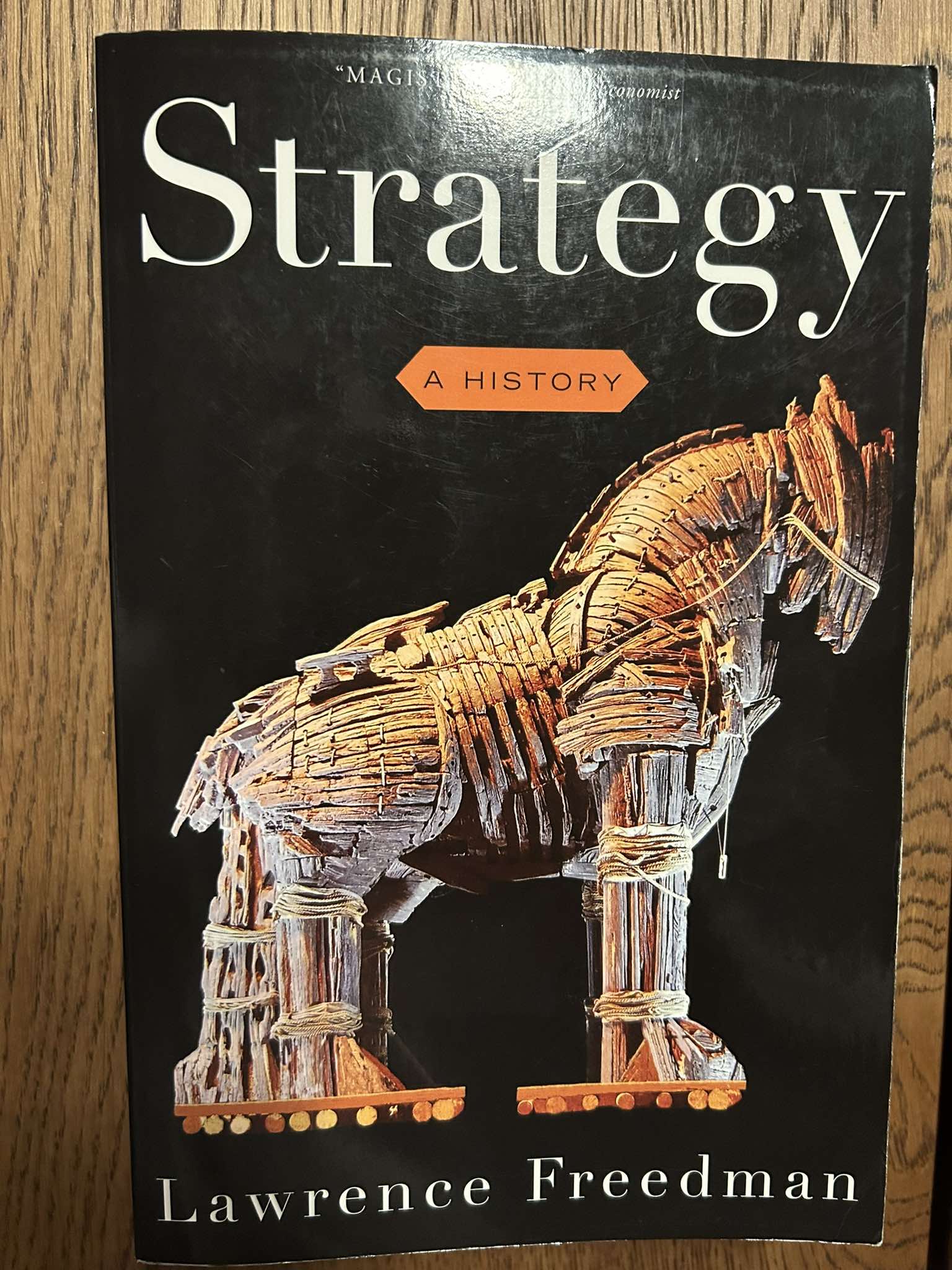
Strategy: A History – Lawrence Freedman

So the realm of strategy is one of bargaining and persuasion as well as threats and pressure, psychological as well as physical effects, and words as well as deeds. This is why strategy is the central political art. It is about getting more out of a situation than the starting balance of power would suggest. It is the art of creating power.

The book is a comprehensive history of strategy, starting from chimpanzees decision-making and going to military, business and political thought. Presented in a chronological order, the book covers all relevant points on what could be included in the topic of strategy: from nuclear war to guerilla tactics, from Cold War to deterrence strategy, from Sun Tzu to Jomini, from business Red Queen to Blue Ocean strategy, from political rational decisions to cooperation and coalition games.

The book feels like a compendium of all important ideas in this domain, describing and commenting on each of them. There is no single message of the book, but appears more like a textbook for those interested in the topic. At points it feels dry, almost academic, with long paragraphs and descriptions. Nevertheless, the ideas are presented in a clear and logic way, and chapters are flowing well one after the other.

The thinkers mentioned and analyzed are mostly American or West European, with few examples from other parts of the world, although the success of non-English thinkers or organizations is mentioned and praised. More examples to captivating theories, or some anecdotes (such as the one describing the movie Mr Smith is sent to Washington) would have elevated the book even further.

Sir Lawrence Freedman, the author of the volume, is an authority on the area, former Professor of War Studies at King’s College London, and largely considered the authority on British strategic studies.

It took me about 8 years to finish the book, which stands at about 700-plus pages, but it was always an interesting read, although slow at times, as profound ideas follow quickly one after the other, paragraph after paragraph.

A must-have book in the library for anyone interested in the topic of strategy from a political, military and business perspectives. This is a book that can stand the test of time, as it contains all influencing ideas and thinkers on strategy until early 2010s.

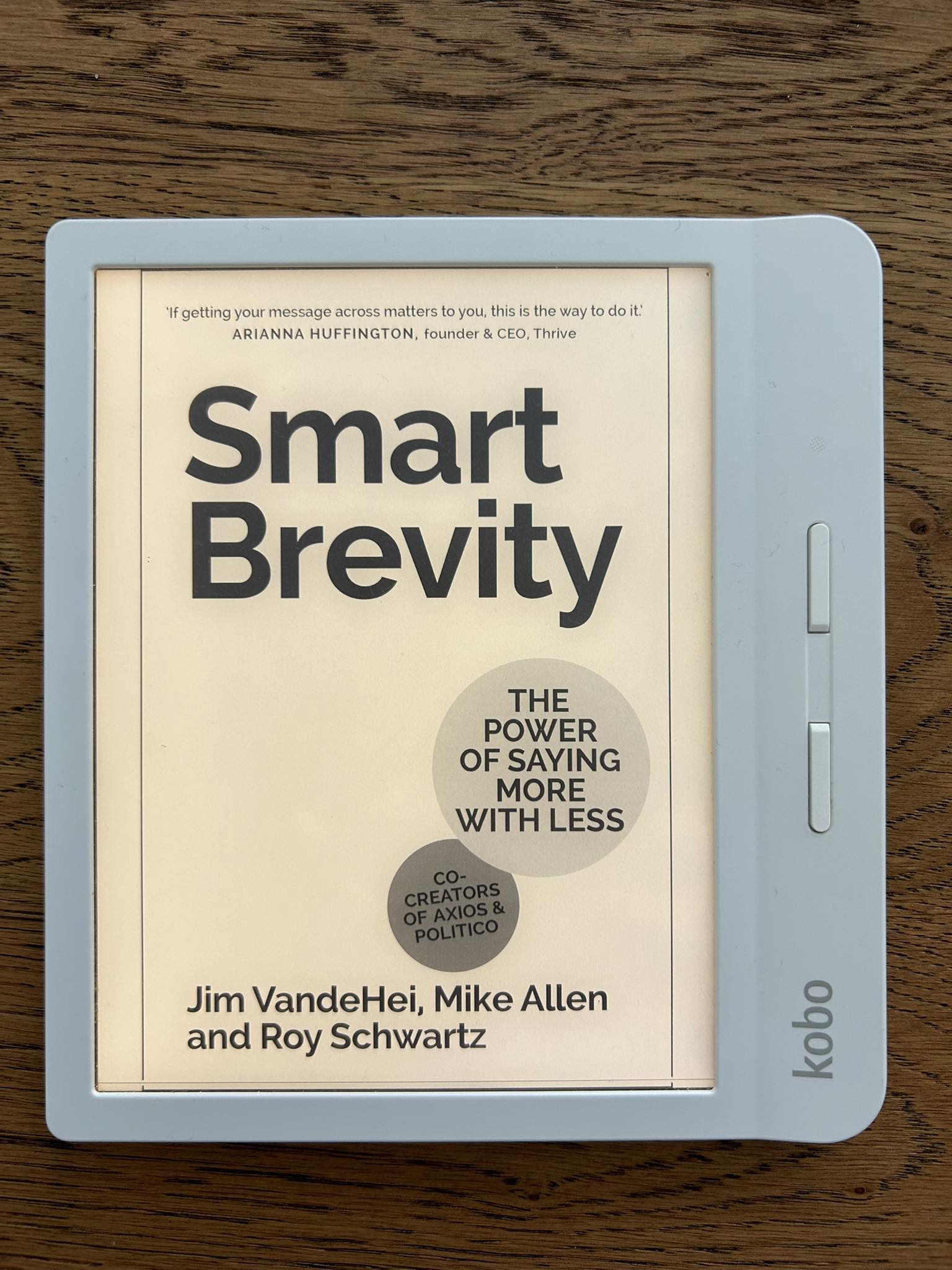
Smart Brevity – Jim Vandehei, Mike Allen, Roy Schwartz

Put your readers first. People are busy and have expectations of the precious time they give you. All they usually want to know is what’s new and “Why it matters.” Give them that.

This is easily one of the best books I have ever read. We communicate to transmit something: a message, an info, a plan, a feeling. This book helps the communicator deliver the message, and it is focused on the professional side (journalists, advocacy professionals, communication experts, etc.). The book helps the reader to get the attention of the audience and have them read, with attention, the message you want to transmit. Short, but full of wisdom gems, the book is a marvel of reading.

Written by the founders of POLITICO (one of the few global political journals making a reputable name in the last decades) it presents their template for writing attention-grabbing and memorable articles, for people interested in political and policy life (and with their attention assaulted by myriads of other messages).

The book is so well written that I will quote them again, on how to build a grabbing message:

Smart Brevity’s Core 4 Smart Brevity, in written form, has four main parts, all easy to learn and put into practice—and then teach. They don’t apply in every circumstance but will help you begin to get your mind around the shifts you need to make.

1 A muscular “tease”: Whether in a tweet, headline or email subject line, you need six or fewer strong words to yank someone’s attention away from Tinder or TikTok.

2 One strong first sentence, or “lede”: Your opening sentence should be the most memorable—tell me something I don’t know, would want to know, should know. Make this sentence as direct, short and sharp as possible.

3 Context, or “Why it matters”: We’re all faking it. Mike and I learned this speaking to Fortune 500 CEOs. We all know a lot about a little. We’re too ashamed or afraid to ask, but we almost always need you to explain why your new fact, idea or thought matters.

4 The choice to learn more, or “Go deeper”: Don’t force someone to read or hear more than they want. Make it their decision. If they decide “yes,” what follows should be truly worth their time.

An example that remained with me: what is more attention-grabbing from the 2 examples below?

Example A: There is water on the moon’s surface, and ice may be widespread in its many shadows, according to a pair of studies published Monday in the journal Nature Astronomy.

Example B: Moon is wet.

This is one of the books that will be a classic, so actual in the world of short-attention spam we have today.

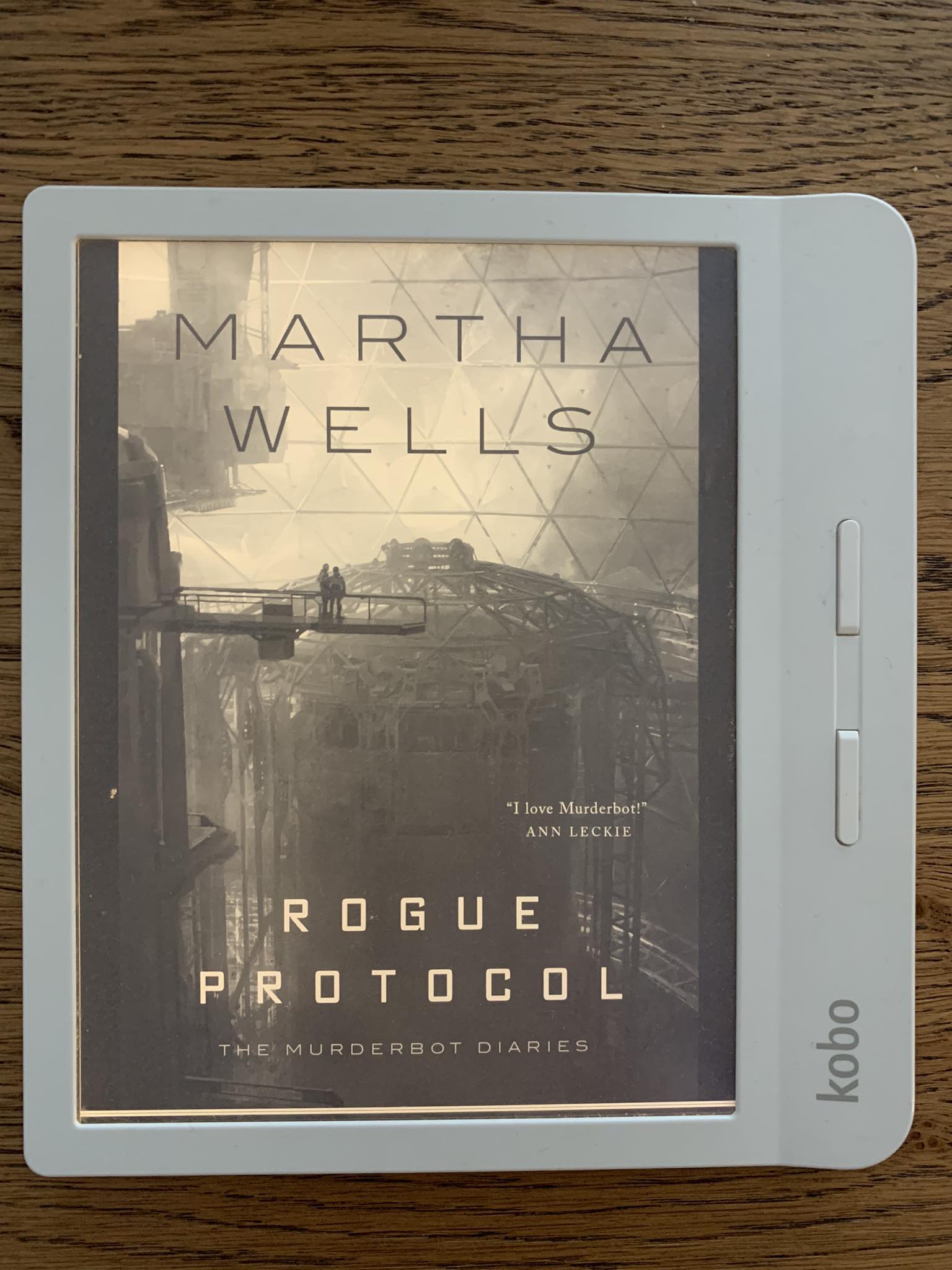
Rogue Protocol (The Murderbot Diaries, book 3) – Martha Wells

I stared straight ahead. If there was one thing good about this situation, it was reinforcing how great my decisions to (a) hack my governor module and (b) escape were. Being a SecUnit sucked. I couldn’t wait to get back to my wild rogue rampage of hitching rides on bot-piloted transports and watching my serials.

In the third book of the series (diaries because the protagonist presents the story in a first-person narrative), our rogue robot heads to a mining outpost to discover more about the past of the company that created it and mysteriously deleted some of its memory. It’s purpose is to investigate some of the stories related to this backwater, semi-abandoned outpost.

Again, the story is immersive and the investigation presents itself as a highly entertaining detective story. What is unique in this series, but particularly in this book, is how the author, Martha Wells, enters in the mind of the reader, asking questions that the reader asks as well, but in comical, ironical way.

The novella (indeed a rather short book) feels lean and the plot is tight, following a protagonist who is gradually developing while learning of the world. Few passages feel over-written, but the best of it, is that there is no endearing impression that part of the plot are missing or that some characters are under-developed. The book feels complete, despite being a novella. Additionally, the way the previous books of the series are referenced is done in short paragraphs, with well-chosen words, with excellent prose and humour.

Again, a lovely book, for a short read in the evening. What a series!

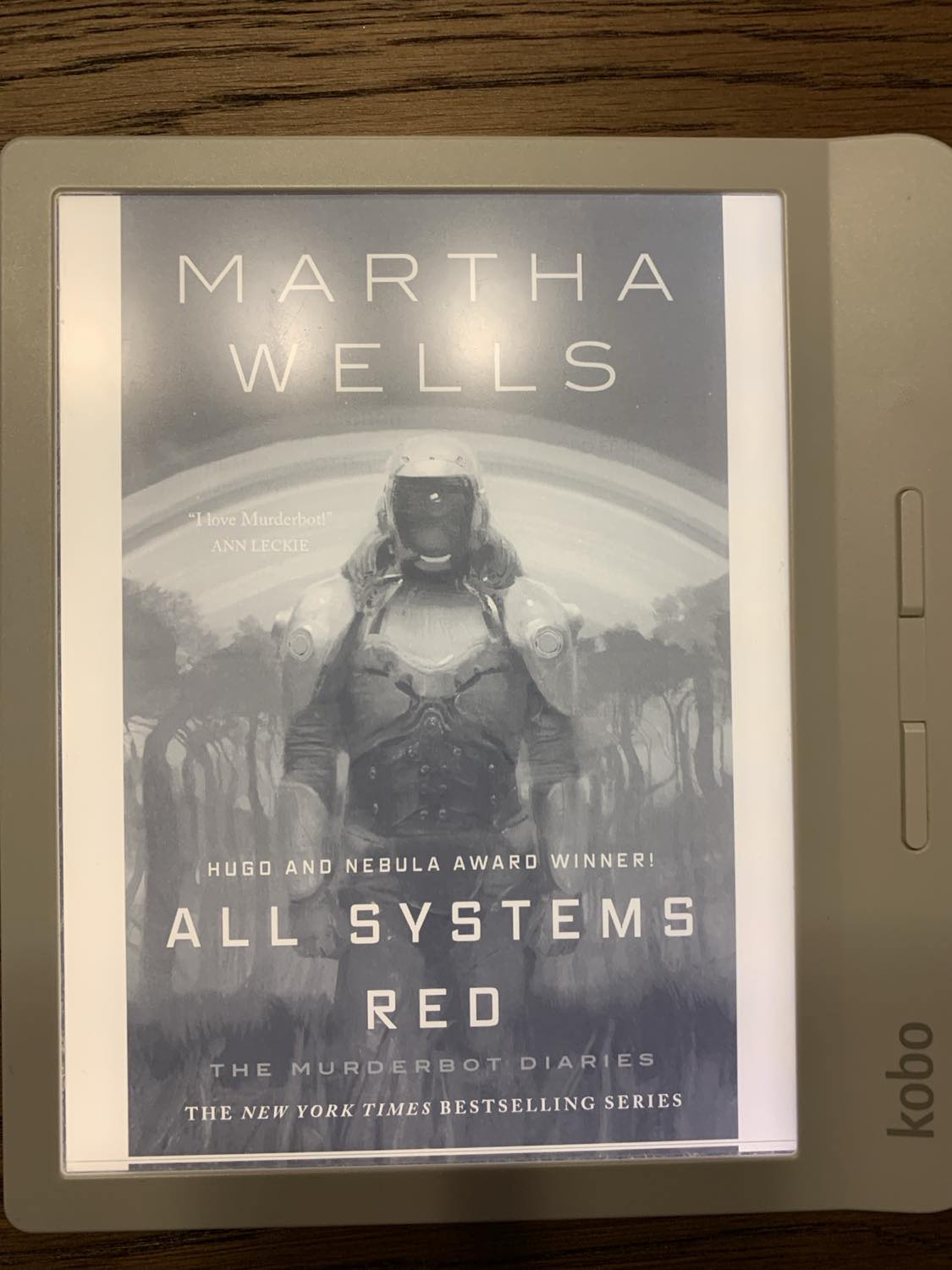
All Systems Red (The Murderbot Diaries, book 1) – Martha Wells

I could have become a mass murderer after I hacked my governor module, but then I realized I could access the combined feed of entertainment channels carried on the company satellites. It had been well over 35,000 hours or so since then, with still not much murdering, but probably, I don’t know, a little under 35,000 hours of movies, serials, books, plays, and music consumed. As a heartless killing machine, I was a terrible failure.

The novella is about a cyborg, in a distant future, designed to protect humans as a security unit, but which becomes independent from its programming. Having the option to do basically anything, the cyborg (which calls itself Murderbot) decides to spend its time watching soap operas. However, circumstances (as it was escorting a research team on an unexplored, but habitable planet) make Murderbot to care more about humans than it previously considered and move it from its languor.

The book is narrated as first person by the cyborg, hence the title of The Murderbot Diaries. In a close to detective story, it explores the journey from indifference to caring for people, . However, the journey is done in a light and funny way, full doubts and timidity.

What impresses, besides the compelling storytelling and great writing, is the world development. We are in a futuristic world dominated by corporations that push the boundaries of humanity. The travel is by wormhole, but the author doesn’t lose words into describing the technologies. They are just there, doing a function, and they naturally feel familiar. The narrator doesn’t need to describe them, which makes the story very fluid.

The novella was widely acclaimed in the science fiction literature. In this genre, there are two major honours, the Nebula and Hugo Awards. The novella from Martha Wells won both awards for best novella, an impressive accomplishment.

The book is the first in the series, the Murderbot diaries, currently having six novellas and a full-length novel. Clearly an entertaining series and a great, relaxing read on a rainy evening.

The Long Way to a Small, Angry Planet (Wayfarers Book 1) – Becky Chambers

The truth is, Rosemary, that you are capable of anything. Good or bad. You always have been, and you always will be. Given the right push, you, too, could do horrible things. That darkness exists within all of us. You think every soldier who picked up a cutter gun was a bad person? No. She was just doing what the soldier next to her was doing, who was doing what the soldier next to her was doing, and so on and so on. And I bet most of them — not all, but most — who made it through the war spent a long time after trying to understand what they’d done. Wondering how they ever could have done it in the first place. Wondering when killing became so comfortable.

This is the story of a motley crew, specialized in building “tunnels”, the highways of space and their adventures and individual stories. It is feel good science fiction, where bad events happen and there are bad people, but generally things are going well, there is relative stability and a place for everyone, good or bad.

The world building and character creation are the hallmarks of this novel. The world created makes sense and has enormous depth, the author cleverly staying away from introducing more complex concepts that could trigger deep changes in the society. The characters are each followed and given backstories, motivations and clear roles.

The crew is composed of nine entities: captain Ashby Santoso, a human who is keeping others in check; Dr Chef – an alien, both cook and medic, with little ambition other than to please others; Kizzy Shao – human female, the ship’s mechanic and an explosion of energy and words; Jenks – human dwarf, the software expert, literally in love with the ship’s AI; Sissix – an alien part of a species promiscuous by design, ship’s pilot; Artis Corbin – human male, responsible for life systems support and aloof guy; Lovelace – ship’s advanced and sentient AI; Ohan – alien, ship’s navigator, able to calculate faster than AI by plot armour; and Rosemary Harper – human female, and main protagonist, a runner because of her father shameful acts.

Social diversity is the theme of the book: a world less sexist, transphobic and xenophobic. It is so nice that the book feels almost like a young adult novel, with malice in few quantities; a very sugar sweet world.

Despite the relative lack of action and more often than not romantic character building, the book is quite engaging and creates memorable, unique protagonists. It is one of those books that you either love or drop midway. The sequel of the book, A Closed and Common Orbit, was even highly regarded, finalist for the 2017 Hugo Award for Best Novel. Interestingly, the book is a kind of reflection of its real life origins, being initially self-published via a Kickstarter campaign, where about 50 people sponsored the author to continue writing.

When the Body Says No: The Cost of Hidden Stress – Gabor Maté

When we have been prevented from learning how to say no, our bodies may end up saying it for us.

While it is common knowledge that stress is affecting one’s health, Dr Gabor Mate takes it a step further and analyses the impact of stress on body by looking into a patient’s childhood, relationship with partners, work and life in general.

The book is bold in its suggestion that body is over mind, considering that a person cannot accumulate stress and tension without effect. Dr Mate goes as far as saying that there is a “cancer” profile, where physicians can increase the chances of confirming cancer by looking at a patient’s personality. The ones who always try to help others, cannot say no to demands and are always smiling, those people simply bottle up negative emotions that would surface as an autoimmune disease.

An interest concept put forward by the author is the difference between rage and anger. He promotes the idea that it is ok to be angry and let tension exit the body. An angry person relaxes its body, takes a long breath and lets tension out. This comes in contrast with rage, which is uncontrolled violence (physical, verbal, behavioural). A person in a rage has all muscles contracted, does not breath correctly and accumulates tension.

The cost of hidden stress

The book is full of various medical cases and draws heavily on medical research, making it a somewhat dry reading. Nevertheless, this does not draw from the appeal of understand how our choices are affecting us.

It finishes with Seven A’s of Healing: principles of healing and the prevention of illness from hidden stress:

    • Acceptance – accepting us how we are
    • Awareness – of our bodies and what they are telling us
    • Anger – in Dr. Mate’s view, anger has cognitive value and works as a way to release tension and negative emotions
    • Autonomy – independent thoughts and actions
    • Attachment – being connected with others is healing
    • Assertion – speak up for ourselves
    • Affirmation – affirming our creating selves, and also our connection to something bigger.

    The book is really wonderful and warmly recommend to read, whenever we feel that life takes over us.

    Factfulness – Hans Rosling

    This is data as you have never known it: it is data as therapy. It is understanding as a source of mental peace. Because the world is not as dramatic as it seems. Factfulness, like a healthy diet and regular exercise, can and should become part of your daily life. Start to practice it, and you will be able to replace your overdramatic worldview with a worldview based on facts. You will be able to get the world right without learning it by heart. You will make better decisions, stay alert to real dangers and possibilities, and avoid being constantly stressed about the wrong things.

    The central idea of the book is that world is much better than you think and it is getting better. Hans Rosling presents with data how world improved over time and shows with surveys how pessimistic without cause the reader is. While not perfect, the world is indeed getting better and the author presents the pessimistic biases we have.

    The book is structured in 10 chapters, presenting an instinct that we must be aware from:

    1. The Gap Instinct
    2. The Negativity Instinct
    3. The Straight Line Instinct Exercise: Question Your Assumptions
    4. The Fear Instinct
    5. The Size Instinct
    6. The Generalization Instinct Exercise: Getting the Full Picture
    7. The Destiny Instinct
    8. The Single Perspective Instinct
    9. The Blame Instinct
    10. The Urgency Instinct

    The book was written in the last months of life of Doctor Hans Rosling and seems to encompass his last message to the world: that we should leave bias and look for data, which will help us to create a better world and be more successful in medicine, business and development.

    The book is thoroughly entertaining, full of imagines and survey questions that make the read a pleasure. It challenges the reader to rethink the world around. What is really the masterstroke is presenting data in a way that is easy to understand and delivers a clear message.

    One of the most thought-provoking, well-written books on the world and developing trends currently on the shelves.

    The Virus in the Age of Madness – Bernard-Henri Lévy

    They knew that Pascal’s room, Thoreau’s hut, and especially their own den was a dark chamber, an unhealthy space full of resentment; they knew that one is nothing when alone, that one thinks most often of nothing at all, and that hell is not other people, but the self.

    This short book is a collection of thoughts regarding the Covid-19 pandemic from the French philosopher Bernard-Henri Lévy. Originally in French, the essay discusses the politics of the pandemic, wondering if the measures taken by governments are good or bad, the reaction of the media, and what we, humanity, should do collectively and individually in these circumstances.

    The references to French literature and influential philosophers betray the cultural range and depth of Lévy , without being didactic. The media referenced is rather balanced, neither progressive or conservative, and covers both sides of the Atlantic.

    The message of the book is a caution against human atomisation, using all the benefits of isolation, made possible by current technology. Food, clothes, items, can be ordered with a simple click. Communication can be done virtually. But the essential human touch cannot be ordered online. Staying at home cannot be praised, it is essentially anti-humane.

    Furthermore, individual liberties are disappearing, in face of distancing and confinement measures. Once taken away, it is hard to restate them. The democratic model itself is at stake, with other socioeconomic models vying for top spot. Media is focusing too much on the virus, while other grave problems remain in the dark: global warming, refugee crises, dictatorships, feeble democracies sliding into authoritarianism. But also good news are fewer in the pages of journals and screens of TVs, we know less about the good in the world.

    Lévy also warns about future pandemics. Humanity has lived with major pandemics all its history. What do we do if we another pandemic hits in five years time? Do we close again the economy? Measures against the spreading are needed, such as social distancing, but need to be debated, rationalized and lessons of the pandemic need to be learn. Because another pandemic is around the corner.

    The book invites to reflection, to think about what makes us human. It is a book about courage, in face of illness. And finally, it is a warning for the human isolation that technology now allows. Isolation cannot be praised, as if we do, we lose our humanity, the French philosopher argues.

    The 7 Habits of Highly Effective People – Stephen R. Covey

    Habit 1: Be Proactive

    Habit 2: Begin with the End in Mind

    Habit 3: Put First Things First

    Habit 4: Think Win/Win

    Habit 5: Seek First to Understand, Then to Be Understood

    Habit 6: Synergize

    Habit 7: Sharpen the Saw

    This is a self-development book with a huge success since it was released in the 1989. Like many self-development books, you are right both if you think it works or of you think it doesn’t.

    The author encourages the reader to divide its life into personal and public spheres and try to improve both by using the good habits he describes. There is no study or research behind the results, except the author’ personal experience and common sense. His Christian belief and principles, clearly confessed in a short paragraph at the end of the volume, is the basis of his philosophy.

    While now synergize and proactive are overused, back in the day they were innovative concepts. Much in vogue in the business schools, the book was popular with managers and people who just want to improve.

    There is nothing new or exceptional in the author’s advice, but just common sense for an active and fulfilling life. The relationship with family, kids, relationships at work are important. Being humble and organized are vital in Stephen Covey’s philosophical system.

    At times, the book seems to force the reader into buying more; being too commercial and aggressive. The advice seems shallow sometimes, without research to back the statements. The arguments appear exaggerated in some circumstances.

    The author passed away in 2014, after an accident, unfortunately.

    Overall, an interesting book, useful for those who want to find their way in life or who are at cross roads.