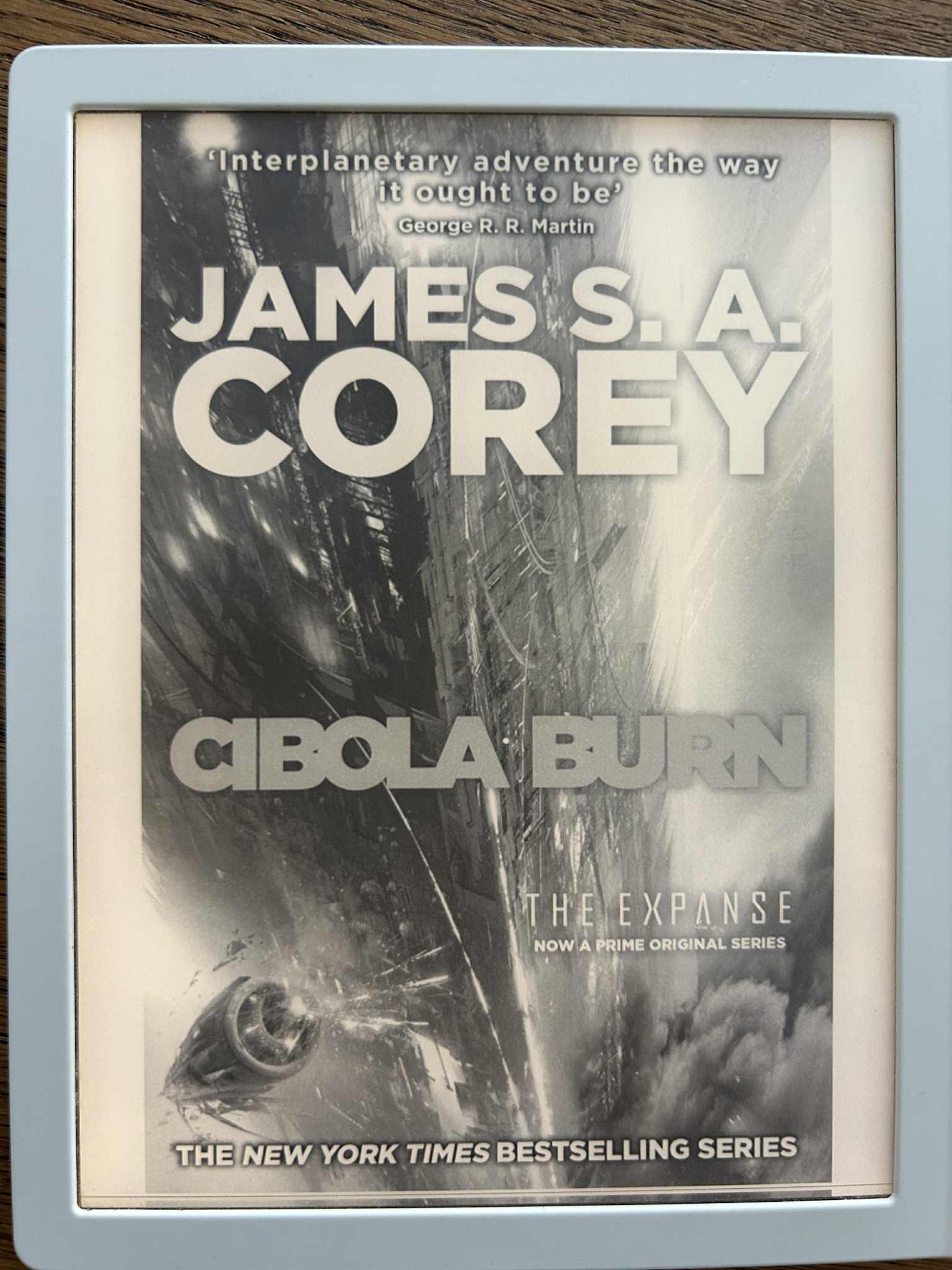
Cibola Burn (The Expanse, book 4)

Apocalyptic explosions, dead reactors, terrorists, mass murder, death-slugs, and now a blindness plague. This is a terrible planet. We should not have come here.

Cibola Burn, the forth book in the Expanse series, continues the story of humanity a few centuries in the future (when the solar system is conquered), where the first planet is explored / colonized following the stars gateway that is build by the alien protomolecule. The fast developments and lack of coordination between the 3 solar powers – Earth, Mars and Belters – make the exploration and colonization of the first planet available a chaotic process, where no one knows who owns the planet (first arrivals? or treaties signed in the Sol system?). How to impose law from years and light-years away?

In this chaotic environment, Holden and his crew is tasked to calm the tensions between the first arrived settlers and the Earth company that was given the rights to the planet. However, the planet is not what it’s looking like, it’s still a remnant of the alien empire that constructed the mysterious protomolecule, able to build a star gate a billion years later. And more puzzlingly, who was this other alien race that could destroy such an advanced and galaxy-wide spread empire?

This book in the series focuses on the planetary exploration, colonisation, survival and orbital manouvers, with a pinch of detective story to inquire over the alien ruins. It’s an engaging book, but felt slow at times. The sheer world-building, hard scifi, characters developments – remain world class.

The book is not as good as the previous 3 ones, where actions scenes, mind-blowing technology and memorable characters (Avasarala, anyone?) were introduced. All of the previous books were a ramp for the next volume of the series; however, after this volume, I am not sure where the story will go. However, I did like the cold calculation that the Earth politician is making over the ramifications for the powers of the Sol system of a star gateway opening. These were the gems of great writing and storytelling that made the book a good one, but not at the level of the others.

Overall, a great scifi series, book 4 / 9 read, and who know what future holds?

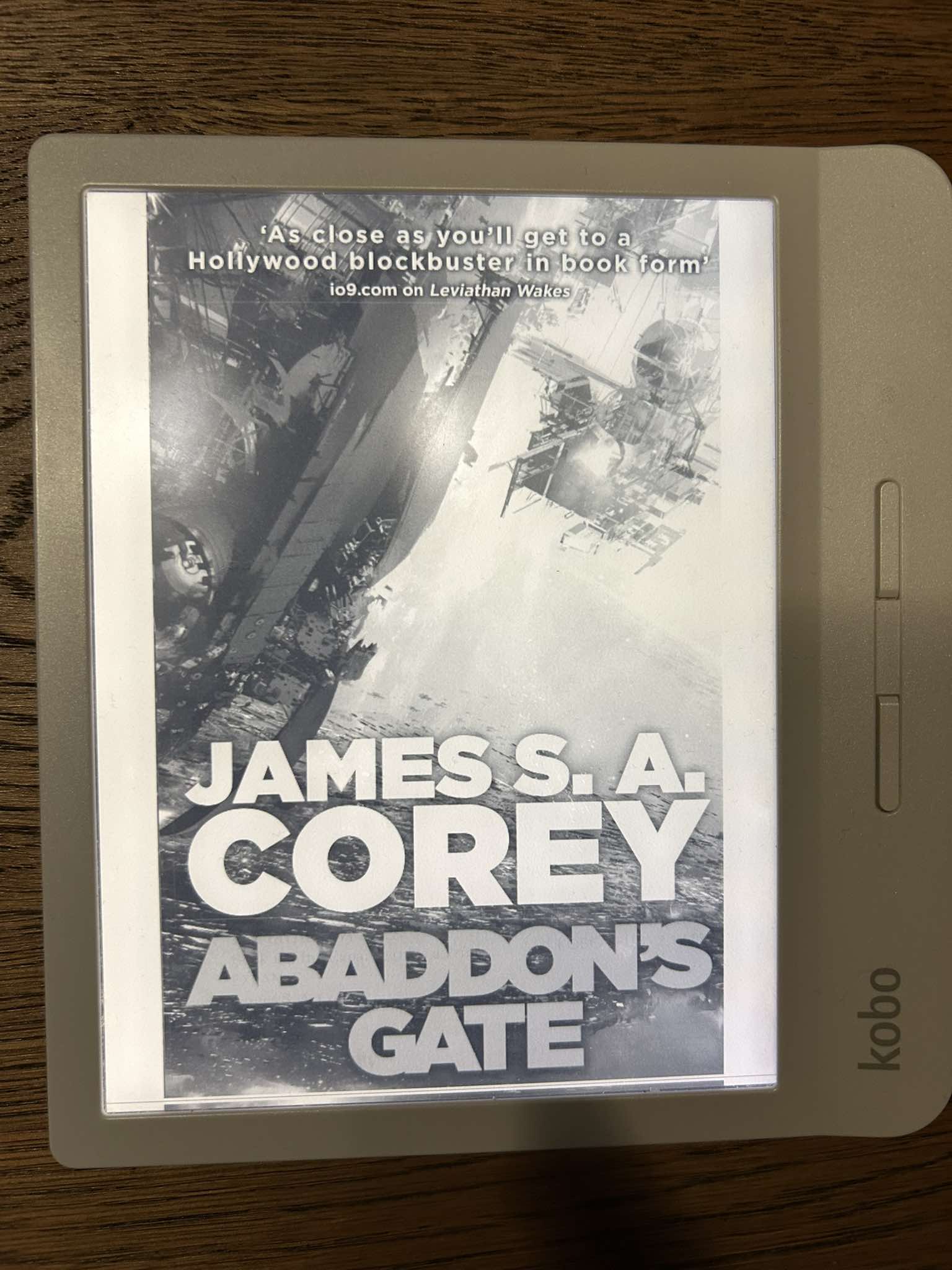
Abaddon’s Gate (The Expanse, book 3)

Violence is what people do when they run out of good ideas. It’s attractive because it’s simple, it’s direct, it’s almost always available as an option. When you can’t think of a good rebuttal for your opponent’s argument, you can always punch them in the face.

Abbandon’s Gate is the third book in the space saga The Expanse, where the action is, this time, in a space bubble built by an alien civilisation. The alien protomolecule built a gate next to Uranus, in the far future of humanity, which conquered our solar system, but not the stars. The humanity is still divided into Earth, Mars and the humans in the asteroid belt, united in the Outer Planets Alliance. All three factions are driven into the gate, and the space bubble, by the running protagonist, the adventurer and captain James Holden.

As in other books of the series, the story follows 4 characters, which gradually reunite in an epic finale. Carlos “Bull” de Baca is the security officer of the Belters’ flagship, the largest ship in the system. Anna Volovodov is a preacher of the Methodist church, volunteering in a United Nations (of Earth) ship to go into the gate. Clarissa Mao, daughter of the rich and powerful Mao (now imprisoned) plots against James Holden, whom she believes created her father’s downfall. Finally, the four story is following James Holden, the captain of Rocinante and its ragtag crew of four.

The gate created by the alien protomolecule opens to a space bubble with thousands of other gates, to other stars, controlled by a central machine. The machine reduces speed and gravity by its will, defying physics. James Holden finds, guided by the mysterious, form that appears as detective Miller (Holden’s dead companion from the first book) that the Godlike alien civilization, spanning hundreds of stars, was destroyed by an even bigger force. And that was 2 billion years ago. But what stays behind those gates? What planets or alien forces?

Interestingly, Abbadon appears in the Hebrew Bible and means destruction or the realm of the dead. This is a reference to the destruction that the gate may bring.

Overall, while a bit weaker than the other book, this is still great storytelling, world building and memorable characters. What a series!

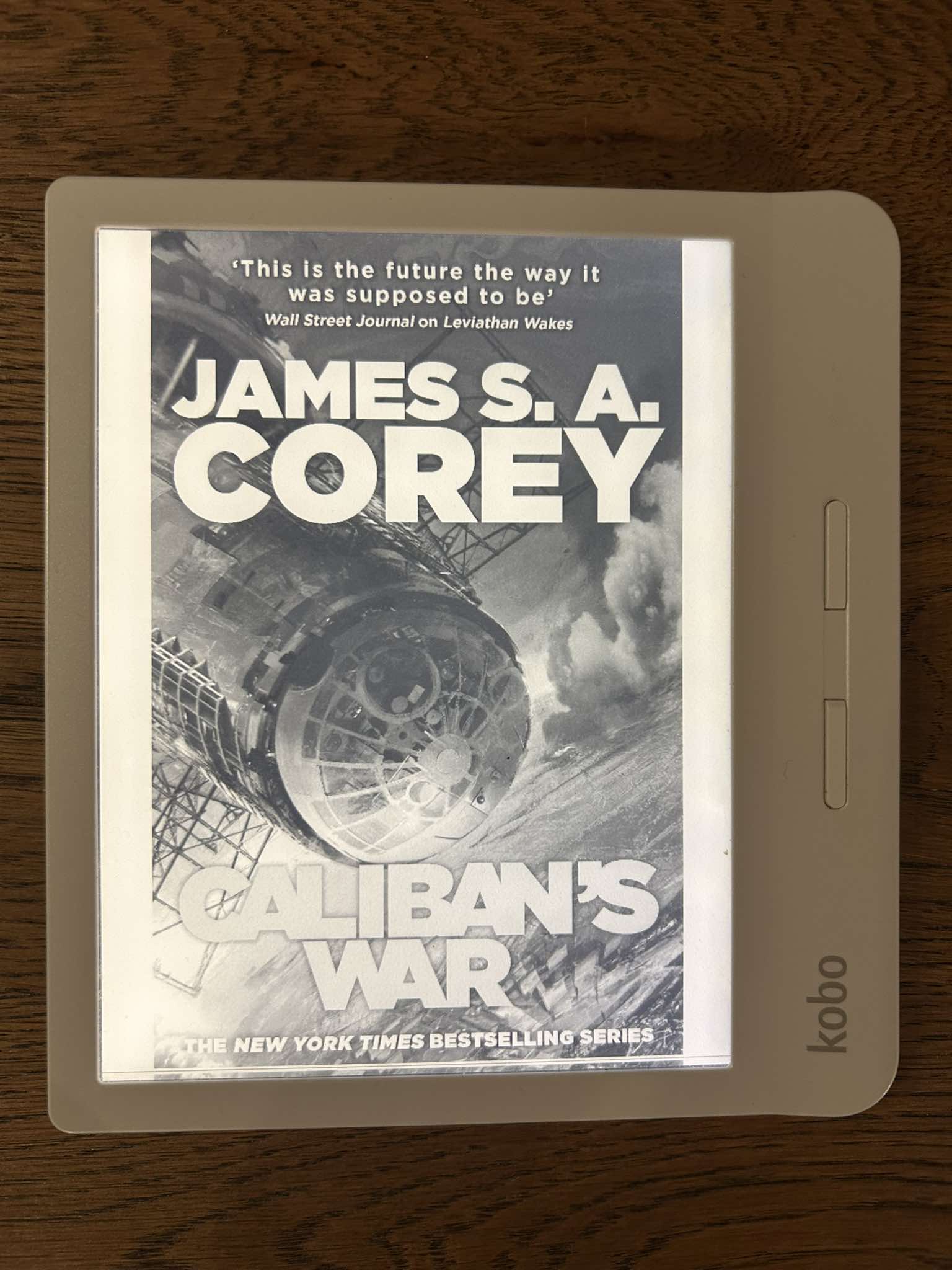
Caliban’s War (The Expanse, book 2)

There was a relentless forward motion to the man. The universe might knock him down over and over again, but unless he was dead, he’d just keep getting up and shuffling ahead toward his goal. Holden thought he had probably been a very good scientist. Thrilled by small victories, undeterred by setbacks. Plodding along until he got to where he needed to be.

The story of the first book, of an alien protomolecule seemingly indestructible, intelligent and lethal to humans, expands to another level, where politicians and planets get involved. The plot is driven ahead by not two, but four protagonists: the captain – James Holden, the doctor – Prax, the politician – Avasarala and the soldier – Bobbie. While each starts from its own background, the protomolecule brings them all together, trying to stop the increasing menace. While planetary governments try to weaponize this alien artefact, the molecule learns and becomes increasingly intelligent. Our four heroes maneuver around politics and dangerous situations to destroy the threat, but the war goes on.

The book introduces two memorable characters: the UN politician from Earth, Avasarala and the Martian female soldier, Bobbie. They team together, more by chance than design, to keep the two planets fighting against the common threat. Avasarala is diminutive, elegant, sophisticated, foul speaking, machiavellian, happily married and old. Bobbie is the opposite.

I rarely continue books in a series, but this space saga is exceptional. Great story building, memorable characters with credible motivations, a tight plot, hard science fiction, great writing – overall, an truly enjoyable reading.

The book’s title is unusual, as Caliban is never mentioned in the book. It is, in fact, a reference to the character Caliban in Shakespeare’s “The Tempest.” This character tries to free himself from subjugation of his masters, as the protomolecule tries to shake the bondage of those who try to weaponize it.

Excellent series, that goes to about 9 books. Long, but worthy reads.

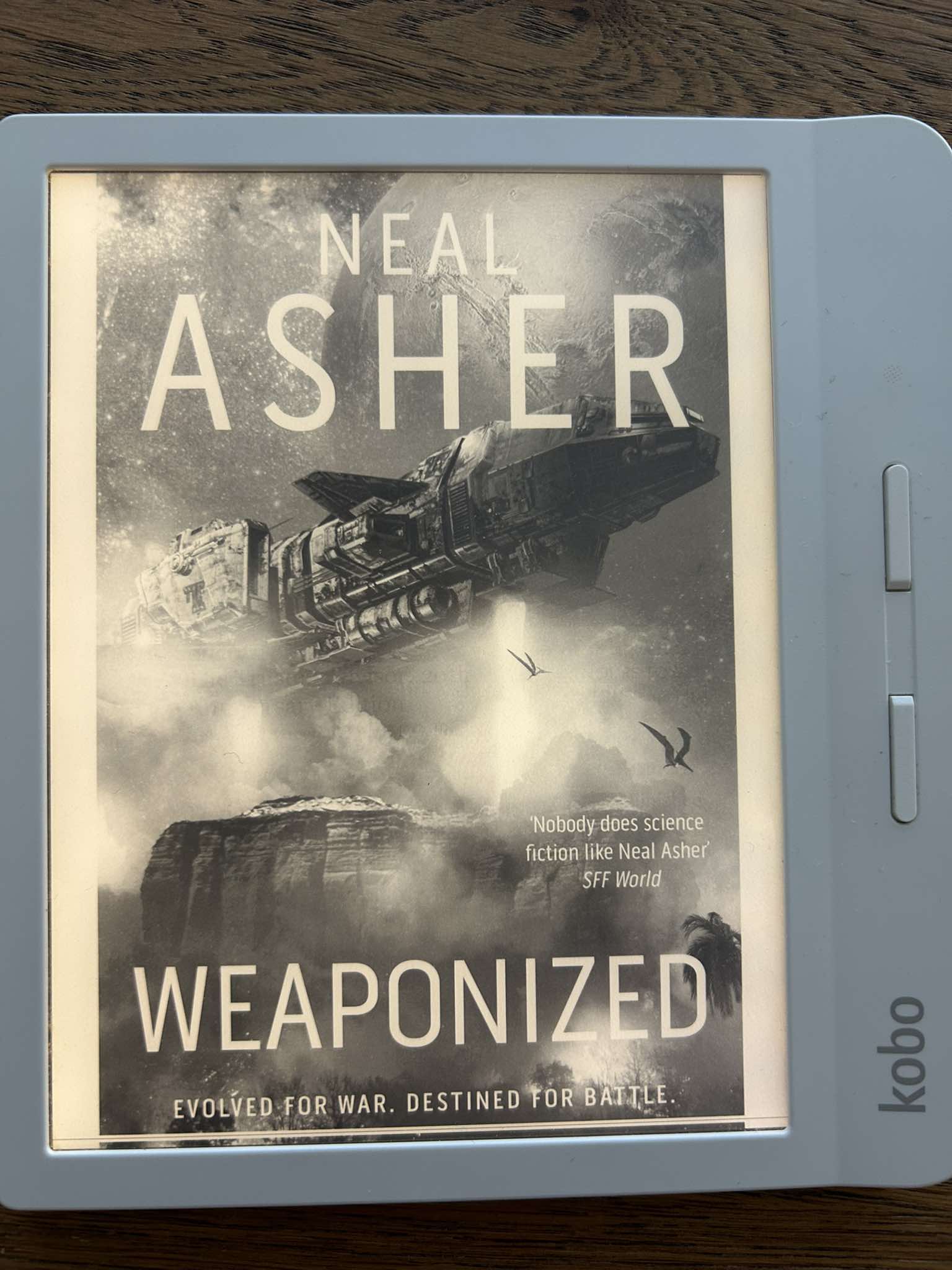
Weaponized – Neal Asher (Polity Universe, first book)

Sometimes, when you fight a war, you become what you are fighting.

Part of the Polity space saga, this book is about a colonisation attempt on a hostile planet, in the far future, where evolution is vital for survival. But not all is what meets the eye and some quiet forces are monitoring and planned the entire ordeal.

This is a hard science fiction story that follows a colonisation leader using AI and continuous adaption to the environment until their own humanity is questioned. The alien animals on the planet, the cacoraptors, are unique in that they adapt to the invaders, changing their bodies shape, but also their level of intelligence to overcome the invaders. How come then that they did use their intelligence capabilities earlier?

In a three ways story, the human colonizers are starting a war with an enemy intelligence, the first ever met. The enemy intelligence, the pradors, land with a damaged ship on this colonizing planed, stating a three ways war. Who will win? Who will adapt best?

This is an engaging and action packed story, with a complex world developing. However, the go and forth in time narrative (past, present, near past) is sometimes confusing, although it does contribute to build the main characters. Developed in the Polity universe, which has more than a dozen books, it is placed chronologically at the beginning of the space saga, but it is not viewed as the best of the series.

Overall, an imaginative and richly build book, by Neil Archer.

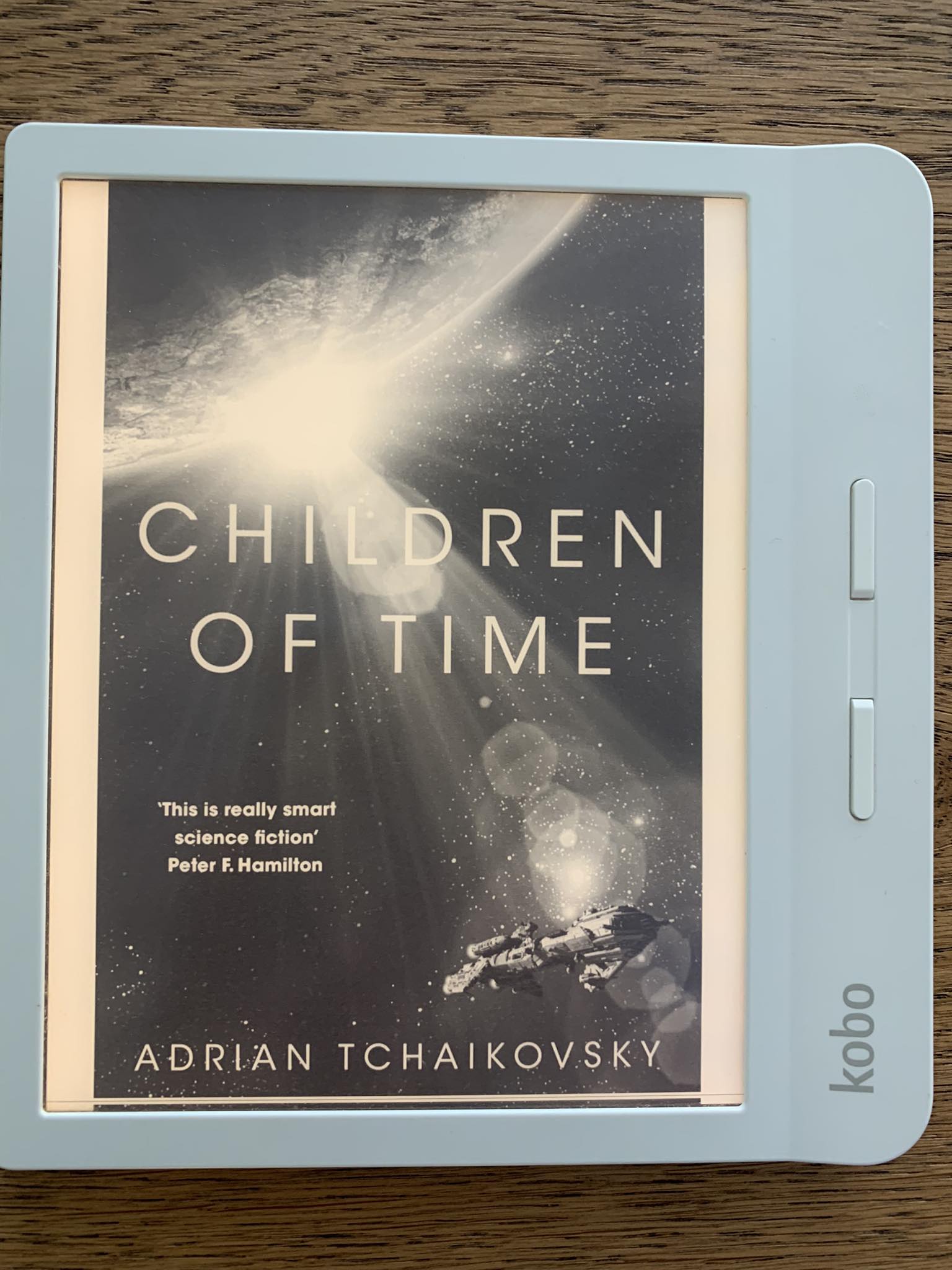
Children of Time – Adrian Tchaikovksy

There had been those back on Earth who claimed the universe cared, and that the survival of humanity was important, destined, meant . They had mostly stayed behind, holding to their corroding faith that some great power would weigh in on their behalf if only things became so very bad. Perhaps it had: those on the ark ship could never know for sure. Holsten had his own beliefs, though, and they did not encompass salvation by any means other than the hand of mankind itself.

This science fiction book is a grappling story of a race for survival for humanity, escaping a poisoned Earth, in an ark traveling the stars towards a new home. The terraforming process that the old, tech advanced Earth has started elevates a species to unprecedented cognitive levels. The human, ark-traveling, last refugees and the legacy of old Earth are heading for a clash.

Children of Time started the series with the homonym name. The book, from 2015, is widely acclaimed and was awarded the Arthur C Clarke book prize.

The themes explored by the author Adrian Tchaikovsky, alienness, star travel, species evolution, disaster, artificial intelligence, survival, cryo sleep, display profound thinking of how these themes may occur in the future and what would be the effects.

A gem of classic science fiction literature.

Well-paced plot, fluid writing, memorable characters, an engaging story, an unpredictable plot and profound themes explored – make the ingredients of a milestone setting book. A truly enjoyable and captivating read, on par with Alaistair Reynolds and Kim Stanley Robinson.

[Cover photo by AndreyC called River on Pixabay.]

Project Hail Mary – Andy Weir

Oh thank God. I can’t imagine explaining “sleep” to someone who had never heard of it. Hey, I’m going to fall unconscious and hallucinate for a while. By the way, I spend a third of my time doing this. And if I can’t do it for a while, I go insane and eventually die. No need for concern.

The book follows the story of the sole survivor of a human crew in their interstellar voyage to find a cure for the microbes that infect the sun and threaten the future of humanity. The narrative is a mix of hard science fiction with comedy.

What a book! For hard science fictions fans this is an almost perfect combination of hard astronomy and physics lessons, a very credible plot, humour, aliens and survival in space. I could not leave the book from my hands.

The story starts with an unexpected dimming of the sun that quickly is determined to be by an infection with some mysterious microbes that simply take energy from the sun and then travel to the highest carbon dioxide-heavy planet (it’s not Earth) to reproduce, return to the sun and restart the cycle. On the other hand, the microbes store immense energy, which changes all interstellar travel paradigm. The dimming of the sun will have rather quickly catastrophic effects on Earth, in only a few decades. All stars around our solar system dim, except one.

A crew is quickly assembled to find if this star has any solutions to Earth’s problems, but only our protagonist survives. And the quest begins.

What is most engaging in this book is that there is no secret recipe, no luck involved, just hard work and using existing tools offered by science and environment. Problems come one after another, but through determination and team work, they are gradually resolved.

A superb book by the author of “The Martian”! I really enjoyed it.

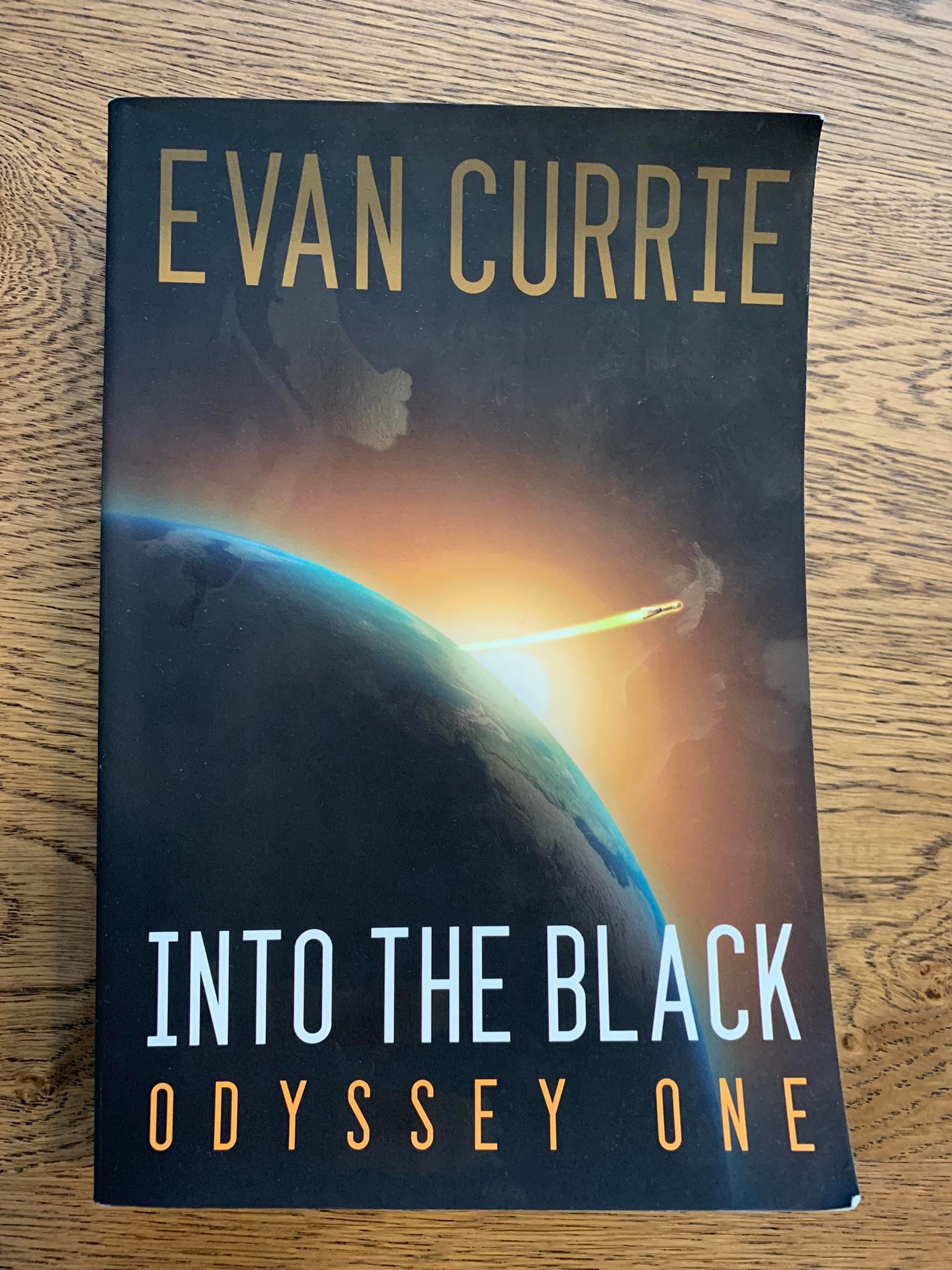
Odyssey One: Into the Black (Odyssey One, book 1) – Evan Currie

A soldier’s first duty, his reason for being, is not to fight. Fighting is the final recourse for any civilized people. His duty is not even to preserve the peace; that is a police officer’s job,” Comdr. Stephen Michaels of the NAC military said by rote, remembering the many long nights of arguments and discussions that had brought this to his mind. “A soldier’s first duty is simply to stand between his nation and any who might wish it harm.

The book follows the voyage of the first interstellar human ship, more of a warship than an explorer. The first star visited outside our solar system triggers a chain reaction driving the ship to new and exciting adventures, discovering new aliens and technologies.

The book is a heavy military scifi, looking at war and fighting from three perspectives: spaceship to spaceship; fighter plane to fighter plane, in space; and futuristic soldiers on new planets. The military theme is heavy throughout the book, the author giving significant thought to what war will look like in several centuries.

From this perspective, the book is a masterpiece, looking deeply of how conflict evolves and the role of the soldier. The world is nicely build around this, creating a believable space saga. From a military perspective, the book is a hard scifi, with an interesting plot and engaging storyline.

On the other hand, the book suffers on the level of personages, which are a bit cliches. They are not truly memorable. We have the wise, heroic and balanced captain; the wacky scientist; the professional and respectful crew; the daring pilots and the merciless aliens. The vocabulary as well could be improved, saying more with less words. The plot has some gaps, it seems unusual for an explorer to go for certain danger without leaving a note from the discoveries. While the author tries to reason the decision taken, it still seems off.

The author, Evan Currie, is a prodigious writer of military scifi and tries hard to create believable and engaging stories with his series of books, the current book (Into The Black) being the first of the series called Odyssey One, which is the name of the exploring ship.

Overall, the book was a relaxing Sunday afternoon reading, which doesn’t pose significant existential questions or substantial moral dilemmas. Nevertheless, for the fans of the genre, it is a an exciting, believable story, with an interesting plot.

The Long Way to a Small, Angry Planet (Wayfarers Book 1) – Becky Chambers

The truth is, Rosemary, that you are capable of anything. Good or bad. You always have been, and you always will be. Given the right push, you, too, could do horrible things. That darkness exists within all of us. You think every soldier who picked up a cutter gun was a bad person? No. She was just doing what the soldier next to her was doing, who was doing what the soldier next to her was doing, and so on and so on. And I bet most of them — not all, but most — who made it through the war spent a long time after trying to understand what they’d done. Wondering how they ever could have done it in the first place. Wondering when killing became so comfortable.

This is the story of a motley crew, specialized in building “tunnels”, the highways of space and their adventures and individual stories. It is feel good science fiction, where bad events happen and there are bad people, but generally things are going well, there is relative stability and a place for everyone, good or bad.

The world building and character creation are the hallmarks of this novel. The world created makes sense and has enormous depth, the author cleverly staying away from introducing more complex concepts that could trigger deep changes in the society. The characters are each followed and given backstories, motivations and clear roles.

The crew is composed of nine entities: captain Ashby Santoso, a human who is keeping others in check; Dr Chef – an alien, both cook and medic, with little ambition other than to please others; Kizzy Shao – human female, the ship’s mechanic and an explosion of energy and words; Jenks – human dwarf, the software expert, literally in love with the ship’s AI; Sissix – an alien part of a species promiscuous by design, ship’s pilot; Artis Corbin – human male, responsible for life systems support and aloof guy; Lovelace – ship’s advanced and sentient AI; Ohan – alien, ship’s navigator, able to calculate faster than AI by plot armour; and Rosemary Harper – human female, and main protagonist, a runner because of her father shameful acts.

Social diversity is the theme of the book: a world less sexist, transphobic and xenophobic. It is so nice that the book feels almost like a young adult novel, with malice in few quantities; a very sugar sweet world.

Despite the relative lack of action and more often than not romantic character building, the book is quite engaging and creates memorable, unique protagonists. It is one of those books that you either love or drop midway. The sequel of the book, A Closed and Common Orbit, was even highly regarded, finalist for the 2017 Hugo Award for Best Novel. Interestingly, the book is a kind of reflection of its real life origins, being initially self-published via a Kickstarter campaign, where about 50 people sponsored the author to continue writing.

Shards of Earth – Adrian Tchaikovsky (The Final Architecture, book 1)

What’s the point of making better people, if they’re still sad and afraid and lonely?

The book follows the story of a space pilot, capable of unique feats, and a soldier, driven by duty and skill, in a futuristic galaxy, where strange aliens seem bound to destroy the universe. In a grandiose space opera, the pilot and the soldier take part in wars and in a motley crew, carried around by the threat of the Architects, the destroyer of planets.

The book is the first part of a trilogy The Final Architecture, but can stand alone and does not finish with a major cliffhanger. Tchaikovsky is increasingly appreciated as one of the best upcoming scifi authors, already winning the Arthur C. Clarke Award and Hugo Award.

Shards of Earth is entertaining, credible and memorable. The reader becomes interested in the fate of protagonists, how the world events are affecting them and how are they responding. The plot is well constructed and there are almost no points where the reader is baffled by the luck or invulnerability of the personages. On the contrary, the heroes of the story do not escape their adventures unscathed. The supporting personages are unique and memorable, with their own motivations and different, interesting backgrounds.

But what impresses most is the world building, creating aliens and separate human species, planets, ships, language, clothes, food – all deeply thought how would they look in the future, and how would they interact. The socioeconomic developments that drive colonization are well-understood. The decision of planets to side with one faction or the other make sense.

Additionally, the dialogue and descriptions are masterfully written, with memorable quotes and presentations. The descriptions manage to create and explain the new space world, without going in too much length – a sign of a great writer.

While the aliens and the worlds created are not uncommon in the scifi literature, the way their interact, the attention to strong motivations, the vocabulary, the editing and, overall, the excellent writing makes the book really engaging and hard to let down before finishing.

Dreadnaught (The Lost Fleet, Book 7) – Jack Campbell

If you don’t exercise a talent, you get rusty,

The odyssey of Captain Jack Geary and his start fleet continues beyond human-controlled space, into the alien enigmas territory. The captain finds itself again in new and tense situations, but dangers are much higher than during the war with the human Syndics.

Already the 7th volume in the series, the story keeps its appeal and, finally, Jack Campbell responds to some of the criticism and does not repeat the various descriptions of the universe it creates. The book is more ingrained in the space opera, rather than a stand alone book, which was always one of the aims of the author in the previous stories.

This time the war with the Syndics is over and enemy is a mysterious alien civilization. While the plot is simple, it develops well and has enough depth and logic to be plausible. This is indeed one of the strengths of the book – taking wild developments in the far future and then apply logic response to them. There is no silver bullet or magic that saves the day.

Beyond human-controlled space, into the unknown.

The jabs to politicians continue, but it is not a nod to fascism, as, while not explicit, democracy is still seen the best of all forms of socio-economical organisation. The political game makes sense and helps drive the plot forward.

The drawbacks remain the same: a somewhat limited vocabulary, too much focus on dialogue that does not really add more depth to characters, too little description of the universe it creates.

Nevertheless, it is astonishing how the series keeps its appeal, even at the seven volume. Jack Campbell is truly a masterful and ingenious storyteller.