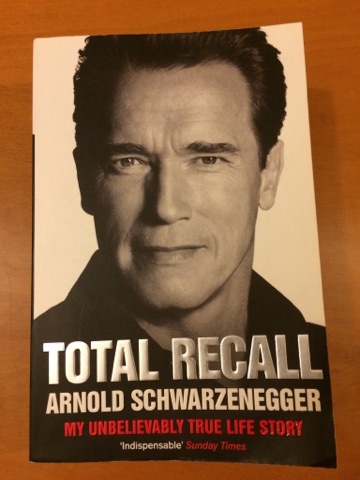
Total Recall: My Unbelievably True Life Story – Arnold Schwarzenegger

Whenever I finished filming a movie, I felt my job was only half done. Every film had to be nurtured in the marketplace. You can have the greatest movie in the world, but if you don’t get it out there, if people don’t know about it, you have nothing.

This is the autobiography of Arnold Schwarzenegger, starting with his childhood in Austria, his first bodybuilding contests, going to the United States, becoming best bodybuilder, then becoming actor, one of the best paid in Hollywood, then businessman, owing city blocks and airplanes, then governor of California. An impressive story by all accounts.

By what Arnold does best is being inspirational, with many, many good quotes in the book. Some readers might know his speech, the 6 rules for success.

1. Trust yourself

2. Break some rules (not the law)

3. Don’t be afraid to fail

4. Ignore the naysayers

5. Work like hell

6. Give something back

Here is an inspirational video, the original speech and the transcript of the speech.
A giant among men

What is impressive about him is the tenacity, the discipline, the ambition and the cold calculations done to succeed. Arnold went well beyond what was necessary to win.

For example, he went to public bodybuilding demonstrations, in parks and prisons, growing the field. Of course, he gained the titles, he was the one growing the bodybuilding business, bringing money and fame for all involved, including referees and competitors. For movies, I quoted him, saying that making the movie is only half the job, the other job being promoting it. Being Governor of California was not a fluke, Arnold going to the Republic Party conferences years ahead his bid to be elected.

He started his first business when he was still competing as bodybuilder, renting apartments. He gradually expanded his real estate, earning millions from his business.

He really left no stone unturned when fighting for a goal he set for himself. His great breakthrough was the acting career and he talks most about coming to the United States and trying to succeed. Bodybuilding was not enough for this man.

He read books, took English classes, business classes, acting classes, everything in his power to become an actor. And like Sylvester Stallone, he never accepted anything less than the main role. He believed in his star and pulled others to do the same.

Arnold was a social butterfly, knowing all the main Hollywood starts BEFORE his first movie. He names dozens of famous people as friends, so his social reach must have been exceptional.

Of course, his book, like any autobiography, shows only his best part, leaving aside failures. The first part of the book talks about his childhood, forming years, coming to America and his first years. The second part is as governor of California and it is mostly on politics, unattractive for some readers.

Overall, Arnold Schwarzenegger is a man of contrasts: he has high discipline for himself, but he cannot be faithful to his wife; he is a bodybuilder, but smokes cigars; he is an environmentalist, but drives a Hummer.

His book is widely considered one of the best inspirational stories that one can read and I fully recommend it.

[Featured picture by Gage Skidmore]
Regulation of the Power Sector – Ignacio Pérez-Arriaga (ed.)

Grids limit the operation of the electricity system in many ways. The most typical limitation is congestion, which occurs when the maximum current that can be handled by a line or other facility is reached, thus determining the amount of electric power that can flow through the element in question. The underlying cause for the limitation may be thermal, and therefore dependent upon the physical characteristics of the facility. It may also be related to the characteristics of system operation as a whole; for instance, provisions to guarantee security in the system’s dynamic response to disturbances or to stability-related problems that usually increase with line length.

Another typical grid constraint is the need to maintain voltages within certain limits at all nodes, which may call for connecting generating units near the node experiencing problems. The maximum allowable short-circuit power established may also limit grid configuration. Generally speaking,
the main effect of grid constraints is to condition system operation and in so doing to cause deviations from economically optimum operation. The most common constraints in distribution grids are related to voltage and maximum line capacity.

“Regulation of the Power Sector” is a comprehensive technical book on the electricity sector, aimed at specialists and advanced students. It encompasses several scholarly fields, including law, economics, regulation, physics and political science.

It is divided into 14 chapters, as follows: I. Technology and Operation of Electric Power Systems; II. Power System Economics; III. Electricity Regulation: Principles and Institutions; IV. Monopoly Regulation; V. Electricity Distribution; VI. Electricity Transmission; VII. Electricity Generation and Wholesale Markets; VIII. Electricity Tariffs; IX. Electricity Retailing; X. Regional Markets; XI. Environmental Regulation; XII. Security of Generation Supply in Electricity Markets; XIII. Electricity and Gas; XIV. Challenges in Power Sector Regulation.

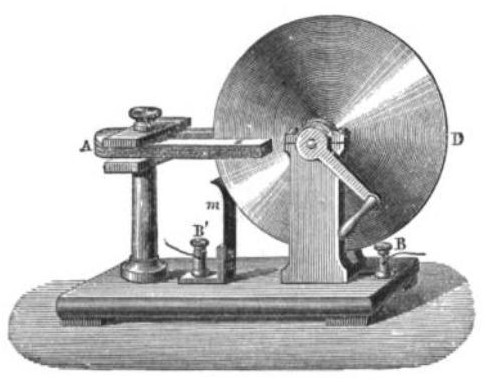
The first electromagnetic generator, invented by Michael Faraday in 1831.

The authors cover pretty much everything in terms of background in energy regulation, with a focus, but not exclusive, to European regulation and market design. The book reads as a manual and goes into detail in explaining why some regulatory decisions were taken. However, it does not push a message or contributes to the scholarly debate, it is more a stocktaking exercise.

The book makes the basis for the Regulation of the Power Sector course at the Florence School of Regulation, a 6-months intensive training for professionals in the area.

The authors are mostly academics and former regulators with plenty of practical examples. What is impressive is that they managed to have a very balanced approach in a highly divisive area.

The volume is not an easy read, some diagrams and formulas taking some time to digest, even for specialists. This is because the book encompasses a very wide range of fields, from formulas taken from the field physics to economic calculations.

For energy professionals, I commend the book, as a very comprehensive summary of energy regulation, theories and basics of the power system. It refreshes knowledge and fills some gaps, in a balanced way.